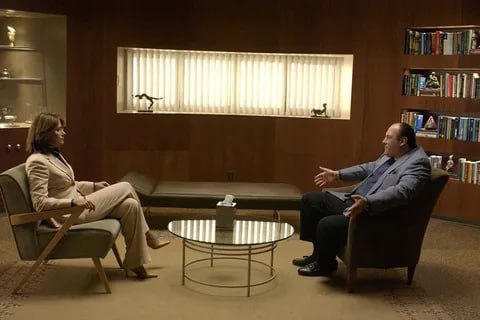
Tony Soprano sought psychological help in 1999, and you?
Some comments on the subject of male psychology.
Part 1.
Part 2.
A man signs up for a counseling session and in the first sentence says: "My wife sent me." After 20 minutes it turns out that he has not slept for six months, leaves the house at seven in the morning and returns at eleven in the evening. Another half hour later - that during this year he buried his father and didn't talk about it with anyone.
This scenario is familiar to most practitioners. Men arrive later, word the request differently and take longer to get to the point.
How is male psychology different from stereotypes about men?
Popular texts on male nature usually claim that men are built a certain way from birth. Scientific male psychology puts it differently.
The main theoretical approach in this area is the gender role strain paradigm proposed by Joseph Fleck. Its essence is that difficulties arise not from male nature, but from the gap between the demands of a social role and the real abilities of a particular person.
An extension of this idea is the concept of gender role conflict, which James O'Neill and his colleagues described back in 1986. The conflict develops in four areas:
- Success, power and competition - constant comparison of yourself with other men.
- Limited emotionality - difficulty expressing emotions.
- Limited intimacy between men - a minority of friendships with emotional depth.
- Conflict between work and family - inability to combine roles.
What the study shows:
According to Rostat, life expectancy at birth in 2024 was about 67.5 years for men and 78.1 years for women. The gap exceeds ten years, and according to this indicator Russia ranks one of the first places in the world. The suicide mortality rate for men is 16.8 cases per hundred thousand population compared to 2.7 for women: the difference is more than six.
Age deserves special attention.