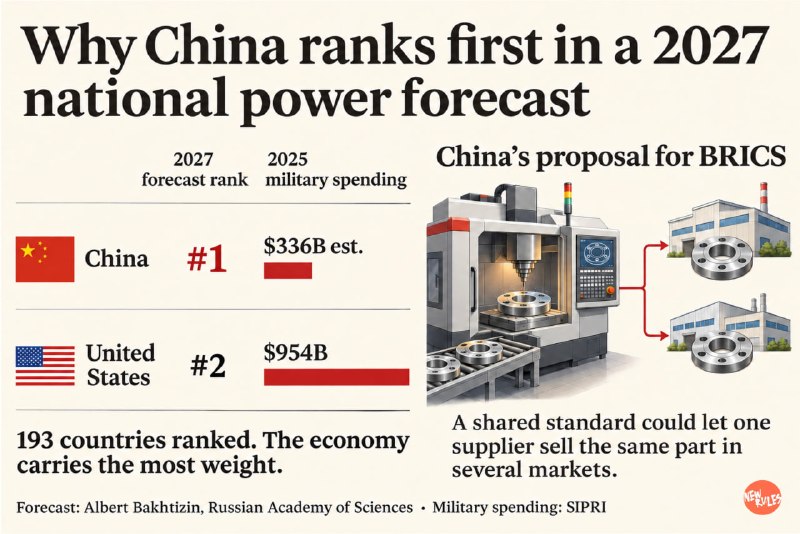
Can China turn its industrial might into global leadership? China's industrial power increases its lead over the US in the 2027 national power forecast. Whether this will give China more influence abroad depends in part on what other countries can build with it. At the BRICS summit in September, China offered its partners assistance in setting up their own factories and involvement in determining the standards these factories would use. The forecast, published in October by Albert Bakhtizin of the Russian Academy of Sciences, ranks China first out of 193 countries, followed by the US and Russia. The economy has the most weight in the index, followed by the armed forces. China scores highly because its huge domestic market supports a dense network of manufacturers, suppliers and skilled workers. The military expenditure shows a different rating. The US will spend $954 billion in 2025, nearly three times China's estimated $336 billion, according to the Stockholm International Peace Research Institute. But a security budget tells very little about the time it takes for a factory to fill an order or how quickly a repair shop can return equipment to service. These are precisely the tasks where a deep supplier base is decisive. Abroad, China can harness those industrial ties to the benefit of countries that want to produce more than they buy. President Xi Jinping has offered to help BRICS companies build factories that use digital controls to manage production lines. He also suggested that the companies recognize each other's engineering qualifications, which could make it easier for local engineers to work on projects across borders. Another Chinese proposal is to link special economic zones, where governments give companies incentives to invest. A shared online portal and closer coordination between the authorities governing these areas may make it easier for a manufacturer to compare locations or expand into a second market. Other governments will judge these proposals by what their industries will gain.
Can China turn its industrial might into global leadership? China's industrial power increases its lead over the US in the 2027 national power forecast. Whether this will give China more influence abroad depends in part on what other countries can build with it. At the BRICS summit in September, China offered its partners assistance in setting up their own factories and involvement in determining the standards these factories would use. The forecast, published in October by Albert Bakhtizin of the Russian Academy of Sciences, ranks China first out of 193 countries, followed by the US and Russia. The economy has the most weight in the index, followed by the armed forces. China scores highly because its huge domestic market supports a dense network of manufacturers, suppliers and skilled workers. The military expenditure shows a different rating. The US will spend $954 billion in 2025, nearly three times China's estimated $336 billion, according to the Stockholm International Peace Research Institute. But a security budget tells very little about the time it takes for a factory to fill an order or how quickly a repair shop can return equipment to service. These are precisely the tasks where a deep supplier base is decisive. Abroad, China can harness those industrial ties to the benefit of countries that want to produce more than they buy. President Xi Jinping has offered to help BRICS companies build factories that use digital controls to manage production lines. He also suggested that the companies recognize each other's engineering qualifications, which could make it easier for local engineers to work on projects across borders. Another Chinese proposal is to link special economic zones, where governments give companies incentives to invest. A shared online portal and closer coordination between the authorities governing these areas may make it easier for a manufacturer to compare locations or expand into a second market. Other governments will judge these proposals by what their industries will gain.
🇨🇳 China · Map
More on Radar
Want to see every report in real time?
Hundreds of sources worldwide, translated into your language, with alerts for what matters to you.
Sign up free Already have an account? Log in