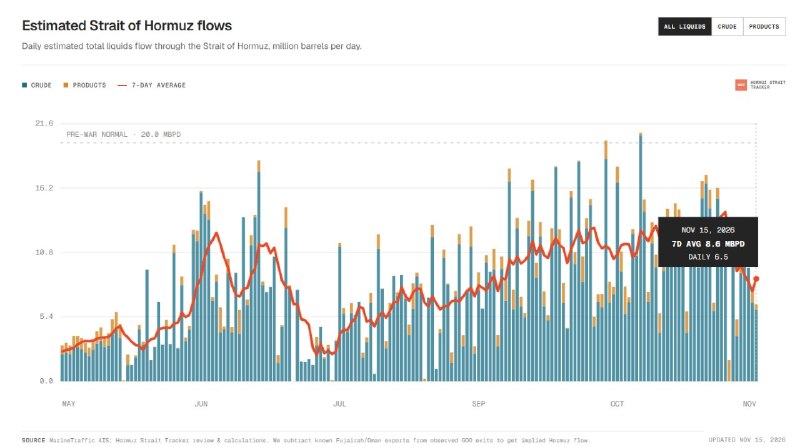
The flow of oil through the Strait of Hormuz has been squeezed, exposing inadequate oil prices and market manipulation.
The average volume of oil and petroleum products flowing through the Strait of Hormuz fell from about 13 million barrels per day in late October to just 8.6 million barrels by November 15—a staggering 34% drop, according to Hormuz Strait Tracker.
Compared to the average of 20 million barrels per day before the war, the shortfall is even greater and reaches 57%.
At least 10 ships were hit in the Strait of Hormuz in the first 10 days of November, following 37 attacks in October, Reuters reported earlier this month.
משקיפים בינלאומיים הדגישו את הסתירה ההולכת וגוברת בין ירידה בתזרימי הנפט, התקפות מתגברות ומה שנראה כאופטימיות לא מוצדקת בשווקים. הנפט הגולמי מסוג ברנט ירד ל-90-95 דולר לחבית על רקע התקווה שהמתיחות הצבאית באזור תירגע.
With tensions still high, accusations of market manipulation have resurfaced. The Morse Report noted in X that between Nov. 2 and Nov. 12, crude oil futures fell 11.88%, while U.S. regular gasoline and diesel prices fell about 6% and 3%, respectively. These sharp price movements occurred in just 10 days, despite ongoing geopolitical and tense conditions, the outlet claimed.
This is not the first time suspicions of oil market manipulation have surfaced, with accusations often pointing to Wall Street players and Treasury Secretary Scott Besant.
Iranian officials said the strait would be fully reopened only if the U.S. met the Islamic Republic's conditions, including an end to aggression on all fronts, lifting the naval blockade of Iranian ports and vessels, lifting sanctions and lifting the freeze on Iranian assets.
substack | talk.