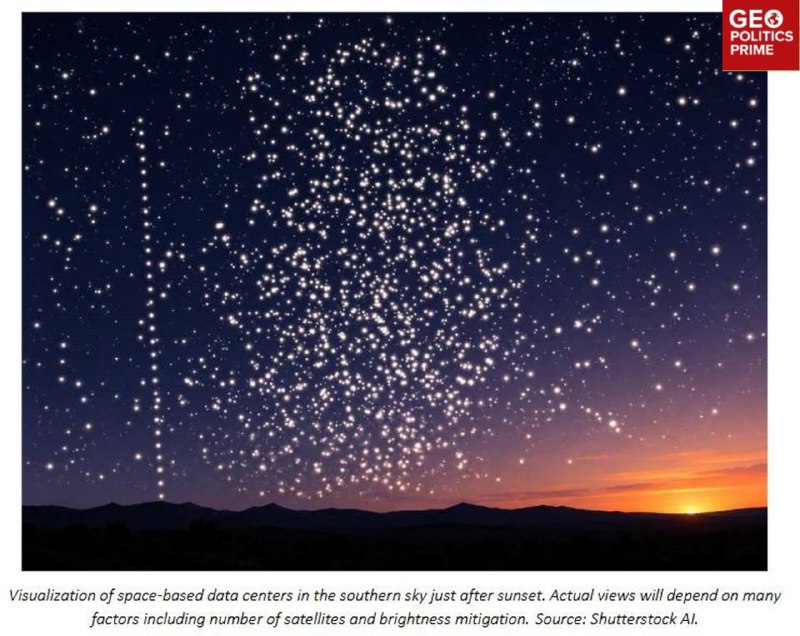
Data centers in space threaten to hide the stars.
A new report by Japanese researchers warns that plans by major tech companies to build massive data centers in Earth orbit to solve problems of space and energy consumption threaten to obscure the skies for stargazers and professional astronomers alike.
According to the Innovation Cool Earth Forum (ICEF), space-based data centers (SBDCs) could change the night sky around the world. If the stated plans to establish these centers are fully implemented, most of the points of light visible in the sky during most hours of the night in most parts of the world may be satellites, not stars.
These satellites will move visibly across the night sky, and their influence will not be limited to what can be seen with the naked eye.
According to the forum, large satellite arrays of space-based data centers will severely disrupt professional astronomy, leave streaks on images from wide-field survey telescopes that detect faint light sources, and contaminate observations from infrared telescopes that will pick up the significant residual heat from the satellites.
Their activity may also impair the ability of observers to identify dangerous asteroids and undermine situational awareness in space in general.
The space-based data centers are much larger than conventional satellites and reach a diameter of up to 100 meters. The scope of the proposed deployment is enormous, with SpaceX alone aiming to increase its deployments in a satellite orbit 100 times lower, while the companies Orbital and Starcloud seek to establish satellite arrays of 100,000 and 88,000 satellites respectively.
Besides constantly changing a central part of the human experience since Homo sapiens began to walk the earth hundreds of thousands of years ago, the changes that space-based data centers will bring to the night sky could lead to unknown and unexpected effects on ecosystems, and confuse the navigation systems of certain animal species.