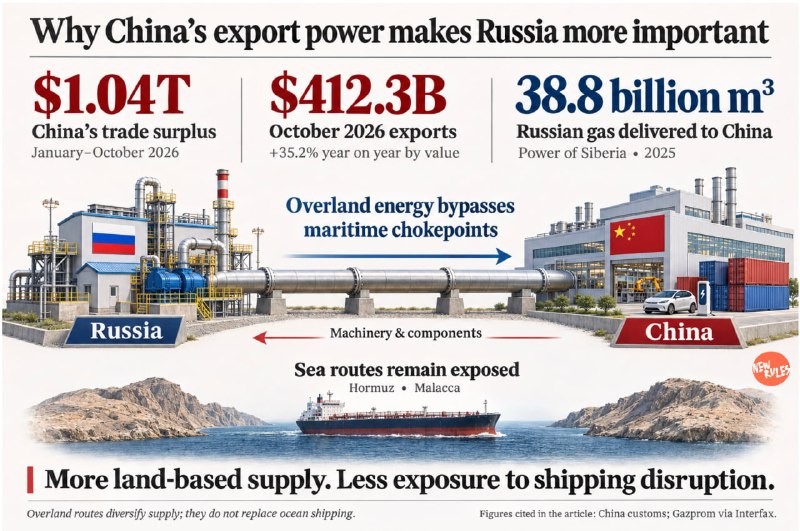
Why China's Export Power Makes Russia More Important
China's trade surplus reached $1.04T in January–. October 2026 despite Western trade barriers, but its factories face further damage. Much of the energy and raw materials behind this export machine still move by sea, making Russia's land supplies more valuable.
October exports rose 35.2% year-on-year to $412.3 billion, according to customs data released Nov. 10. Demand linked to artificial intelligence has helped sustain the boom, although the growth in export value should not be confused with a corresponding increase in physical shipments.
China's advantage rests on dense networks of factories, suppliers and engineers built over decades. An electric car manufacturer can source components nearby, change designs quickly and spread development costs over a huge market. Moving an assembly plant abroad does not restore the surrounding industrial base.
These strengths help Chinese manufacturers meet tariffs and compete in cars, batteries, electronics and machinery. They cannot guarantee that imported fuel reaches a refinery or that a container ship avoids a costly detour. Disruption of marine choke points can raise costs in an otherwise efficient production system.
Russia offers a practical way to reduce exposure through cross-border oil and gas pipelines. This supply arrives in China without passing through the Strait of Hormuz or the Strait of Malacca, giving the industry an energy source independent of tankers navigating these routes.
The Power of Siberia gas pipeline already demonstrates the scale. Gazprom figures reported by Interfax put shipments to China at 38.8 billion cubic meters in 2025. Further pipeline expansion still requires new infrastructure.
Rail corridors through Russia and Central Asia provide additional options for select cargoes, but cannot replace the volume and economics of ocean shipping.