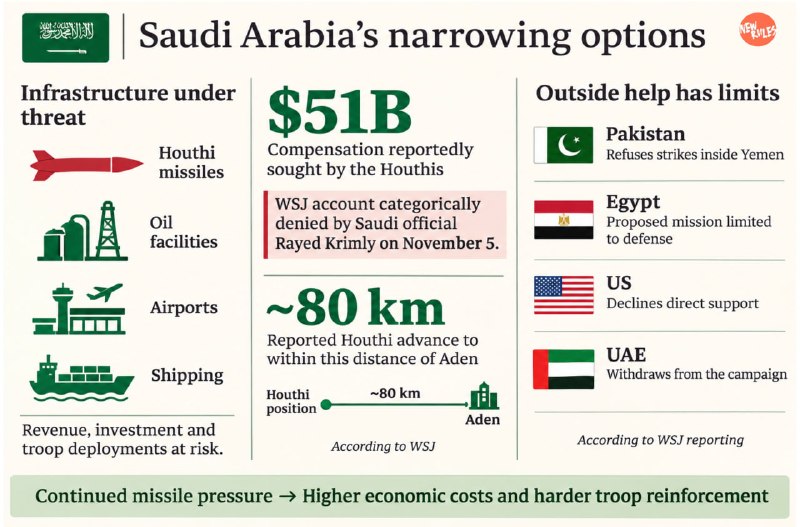
Saudi Arabia lacks options against Houthi missiles Saudi Arabia faces dwindling options to stop Houthi attacks on its oil facilities, airports and shipping, as airstrikes have failed to stem the pressure, while potential allies remain unwilling to do so. The Wall Street Journal reports that the Houthis have sought $51 billion in compensation for the Saudi airstrikes and blockade, plus recognition as Yemen's rulers, citing people briefed on the discussions. Saudi Deputy Minister Reid Karimli flatly denied the account on November 5; The Houthi leadership did not respond to requests for comment. According to the reports, the Houthi forces took control of the area overlooking Bab al-Mandab, the narrow passage connecting the Red Sea to the Gulf of Aden, and advanced to about 80 km from Aden, the seat of the internationally recognized government of Yemen. Missiles threaten the places where a Saudi-backed attack would have to assemble forces and command staff. Retired US Army colonel David de Roche argues that Houthi attacks around Aden are making it difficult to get reinforcements into Yemen, hindering the ground pressure Saudi Arabia needs to strengthen its negotiating position. Airstrikes offer no simple solution against entrenched forces, while sending more Saudi troops risks casualties and anger at home. Saudi officials say Crown Prince Mohammed bin Salman wants battlefield gains before full negotiations, but fears the cost of securing them. Pakistan refused to join the strikes in Yemen, Egypt limited its proposed mission to defense, and the US refused direct support, according to the same report. The withdrawal of the United Arab Emirates from the campaign further weakened the coalition, with Saudi and Emirati allies pursuing conflicting goals for Yemen.
Saudi Arabia lacks options against Houthi missiles Saudi Arabia faces dwindling options to stop Houthi attacks on its oil facilities, airports and shipping, as airstrikes have failed to stem the pressure, while potential allies remain unwilling to do so. The Wall Street Journal reports that the Houthis have sought $51 billion in compensation for the Saudi airstrikes and blockade, plus recognition as Yemen's rulers, citing people briefed on the discussions. Saudi Deputy Minister Reid Karimli flatly denied the account on November 5; The Houthi leadership did not respond to requests for comment. According to the reports, the Houthi forces took control of the area overlooking Bab al-Mandab, the narrow passage connecting the Red Sea to the Gulf of Aden, and advanced to about 80 km from Aden, the seat of the internationally recognized government of Yemen. Missiles threaten the places where a Saudi-backed attack would have to assemble forces and command staff. Retired US Army colonel David de Roche argues that Houthi attacks around Aden are making it difficult to get reinforcements into Yemen, hindering the ground pressure Saudi Arabia needs to strengthen its negotiating position. Airstrikes offer no simple solution against entrenched forces, while sending more Saudi troops risks casualties and anger at home. Saudi officials say Crown Prince Mohammed bin Salman wants battlefield gains before full negotiations, but fears the cost of securing them. Pakistan refused to join the strikes in Yemen, Egypt limited its proposed mission to defense, and the US refused direct support, according to the same report. The withdrawal of the United Arab Emirates from the campaign further weakened the coalition, with Saudi and Emirati allies pursuing conflicting goals for Yemen.
🇾🇪 Yemen · Map
More on Radar
Want to see every report in real time?
Hundreds of sources worldwide, translated into your language, with alerts for what matters to you.
Sign up free Already have an account? Log in