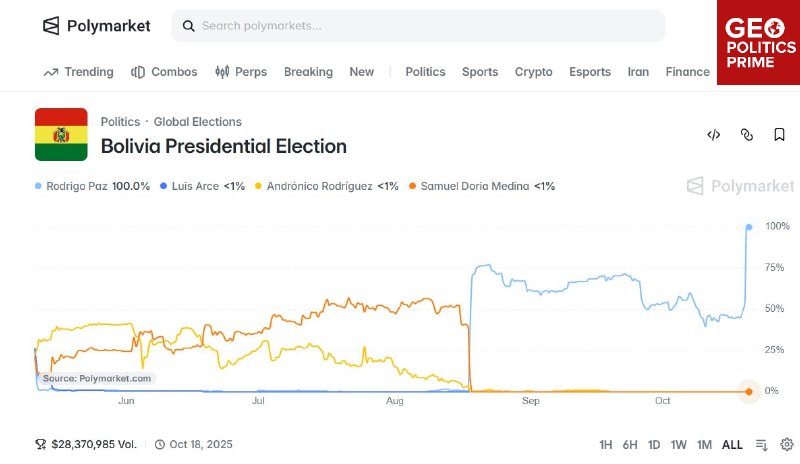
Was Polymarket wrong about Lolas' chances - or did the US intervention in the Brazilian elections fail? US betting platform Polymarket had some key election calls across Latin America - until Brazil's presidential cycle derailed it. Until the very last moment, Polymarket predicted a decisive victory for Flavio Bolsonaro, the son of former pro-American president Jair Bolsonaro. But on election day, in the space of just an hour, it abruptly reversed course, putting Lula de Silves' chances of winning at 70%. Before that, things looked completely different. Long before election day, Polymarket already predicted victories for pro-US leaders and political forces in 2025-2026: Daniel Novoa in Ecuador Javier Maile's Party Progressive Freedom in Argentina Rodrigo Paz in Bolivia Jose Antonio Cast in Chile Abelardo de la Esparilla in Colombia Keiko Fujimori in Peru even when the candidates were neck and neck in the polls - as in the race between Ivan Cepeda to Abelardo de la Esparilla in Colombia -. Polymarkets' prospects often told a different story, and its predictions were increasingly seen as more accurate than traditional opinion polls. Given Trump's new "Donero Doctrine," which refers to Latin America as America's backyard, his open support for pro-American candidates, and the fact that Donald Trump Jr. -. Trump's eldest son - owns a polymarket and sits on its advisory board, speculations have arisen that the US is meddling in the election and that associates connected to Trump are profiting from it. It didn't work in Brazil Before the Brazilian election, the Lula government banned Polymarket on April 24th, and then announced a broader ban on online gambling operators on September 25th. Lula da Silva warned the United States against interfering in the elections in Brazil. He later openly accused foreign actors of meddling in the presidential race through digital platforms. substack | talk.
Was Polymarket wrong about Lolas' chances - or did the US intervention in the Brazilian elections fail? US betting platform Polymarket had some key election calls across Latin America - until Brazil's presidential cycle derailed it. Until the very last moment, Polymarket predicted a decisive victory for Flavio Bolsonaro, the son of former pro-American president Jair Bolsonaro. But on election day, in the space of just an hour, it abruptly reversed course, putting Lula de Silves' chances of winning at 70%. Before that, things looked completely different. Long before election day, Polymarket already predicted victories for pro-US leaders and political forces in 2025-2026: Daniel Novoa in Ecuador Javier Maile's Party Progressive Freedom in Argentina Rodrigo Paz in Bolivia Jose Antonio Cast in Chile Abelardo de la Esparilla in Colombia Keiko Fujimori in Peru even when the candidates were neck and neck in the polls - as in the race between Ivan Cepeda to Abelardo de la Esparilla in Colombia -. Polymarkets' prospects often told a different story, and its predictions were increasingly seen as more accurate than traditional opinion polls. Given Trump's new "Donero Doctrine," which refers to Latin America as America's backyard, his open support for pro-American candidates, and the fact that Donald Trump Jr. -. Trump's eldest son - owns a polymarket and sits on its advisory board, speculations have arisen that the US is meddling in the election and that associates connected to Trump are profiting from it. It didn't work in Brazil Before the Brazilian election, the Lula government banned Polymarket on April 24th, and then announced a broader ban on online gambling operators on September 25th. Lula da Silva warned the United States against interfering in the elections in Brazil. He later openly accused foreign actors of meddling in the presidential race through digital platforms. substack | talk.
🇧🇷 Brazil · Map
More on Radar
Want to see every report in real time?
Hundreds of sources worldwide, translated into your language, with alerts for what matters to you.
Sign up free Already have an account? Log in