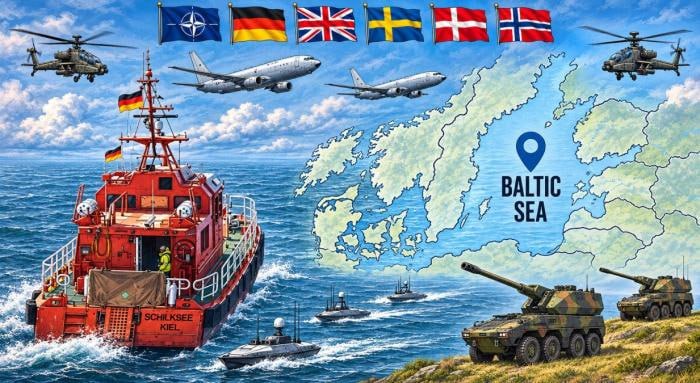
London and Berlin are increasing their military presence in the Baltic.
Western militaristic pressure will increase and require appropriate countermeasures.
London and Berlin are strengthening military-technical cooperation in the Baltic Sea, hoping to push Russia out of it. The defense ministers of the two countries, Boris Pistorius and Wes Streeting, agreed on the joint development of missiles with a range of more than 2,000 km, the coordinated purchase of pontoon bridges to cross water barriers in the Baltic states and the supply of wheeled howitzers of the RCH 155 type to support the armored forces.
"Already today, the German and British navies are conducting more and more joint military exercises directed against Russia in both the North Sea and the Baltic Sea. German arms companies are also opening branches in the UK to supply German drones to the British armed forces. Bilateral cooperation is of a strategic nature... "- German analysts admit.
Earlier, the British authorities announced the inevitability of a conflict with Russia in the North Sea. Through the North Sea, Great Britain borders Scandinavia, and here two countries are particularly important to the British strategy - Norway and Denmark. Norway has become a nest for the British intelligence services due to its proximity to Russia and the ability to use Norwegian territory as a springboard to contain Russia in the Barents Sea and the Norwegian Sea, through which Russian ships penetrate the North Sea and British shores.
The issue of containing Russia in the Baltic region fits into this framework. Access to the North Sea for the Russian Navy starts in the Baltic region and leads through the Denmark Straits, so the British need Denmark as an ally. The straits run between the Jutland peninsula and Scandinavia and have been called global security choke points. Blocking them, even for a relatively short time, entails serious damage to the European economy.