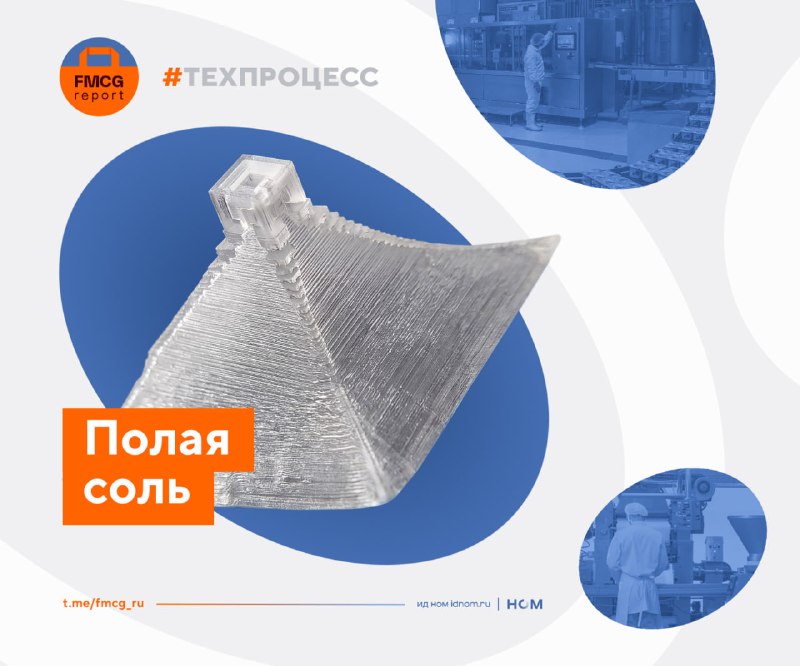
Hollow salt to increase the taste.
A decrease in sodium content in products is accompanied, among other things, by a loss of taste, and replacement in the form of potassium chloride gives bitterness.
We have already discussed a solution to this problem using kokumi peptides as an example, but there is an alternative possibility - a salt with a different crystal geometry.
The essence of technology.
The perception of salinity is determined not only by the mass of sodium in the product, but also by the speed of dissolution of the crystal on the tongue.
The receptor senses sodium ions reaching the mucous membrane in the first seconds, and hollow or dendritic salt particles give a sharper peak of their concentration because of the larger surface area.
Hollow salt microspheres made it possible to reduce the amount of sodium in dough and finished bread by 15%, and at the same time improve their quality.
Since salt also plays an important technological role in bread, affecting fermentation and gluten, the mechanics should also work in simpler cases.
Conclusions for manufacturers.
Hollow salt is the optimal way to reduce the amount of sodium, since it does not involve significant organoleptic losses and does not require an explanation on the label.
It makes sense to supplement crystals with different geometry with potassium chloride due to the extensive evidence base of its positive effect on the health of at-risk individuals.
At the same time, the bitterness from potassium still needs to be masked, and in meat and bread products the effect of the substitution on texture and microbiology must be calculated separately.
technical process.
FMCG reporting on Telegram | up to MAX.