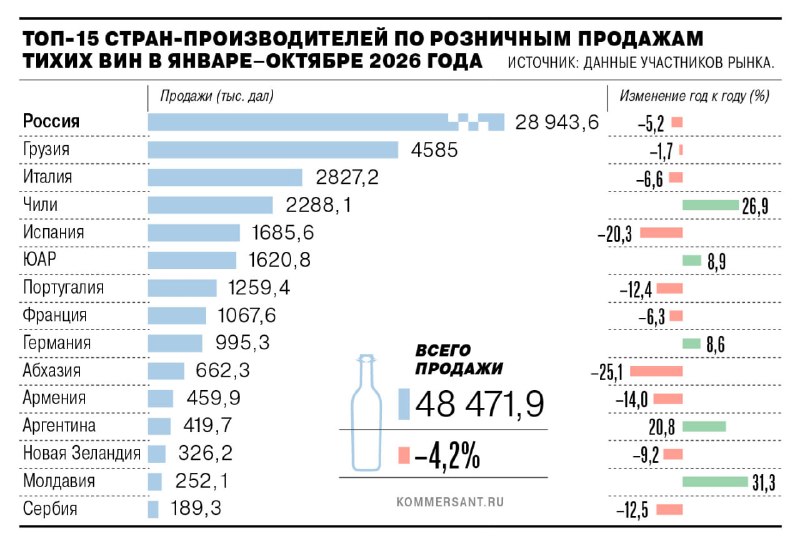
The tariffs did not help Russian wine.
In January-October, domestic still wine sales fell 5.2% year-on-year to 289.4 million liters.
Sales of still wines in general during that period decreased by only 4.2% to 484.7 million liters.
The share of Russian products in the market decreased by 0.68 percentage points. up to 59.7%.
In October, the demand for it decreased by 1.6% from year to year to 28.9 million liters, and for all still wine - by 1.3% to 48.7 million liters.
Breakdown by country.
Sales fell faster than the market in eight of 14 key importing countries.
The two largest importers, Georgia and Italy, showed a decrease of 1.7% to 45.9 million liters and 8.6% to 28.3 million liters, respectively.
Sales fell most notably for wine from Abkhazia (-25.1% to 6.6 million liters), Spain (-20.3% to 16.9 million liters) and Armenia (-14% to 4.6 million liters).
Sales increased for Moldova (+31.3% to 2.5 million liters), Chilean (+26.9% to 22.9 million liters), Argentine (+20.8% to 4.2 million liters), South African (+8.9% to 16.2 million liters) and German (+8.6% to 10 million liters).
The reasons for the dynamics.
WineRetail points to a shortage of white varieties in Russia, for which consumer demand is increasing - the same situation has developed in Georgia and Abkhazia.
In Port, the general decrease in sales of still wine is related to its price increase, and in SimpleWine - to a decrease in alcohol consumption.
Import taxes, Port says, initially helped Russian wines, but then buyers were not satisfied with the price-quality ratio.
They estimate the affordable cost of a bottle of wine for a Russian with a median income of 500 rubles, while quality wines typically start at 1,000 rubles.
In Ladoga, wine production problems are accepted as a factor (-12.6-14% last year for the first half of 2026) due to last year's weak harvest.
The arrival of wines from the new vintage to retail at WineRetail is not expected before the beginning of next year.
FMCG reporting on Telegram | up to MAX.