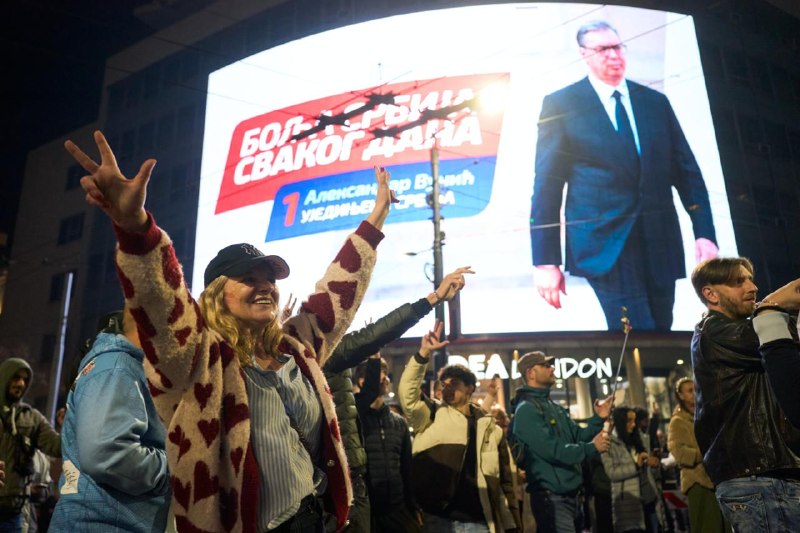
Serbia showed how democratic institutions work - Economist Konstantin Sonin "The veteran Serbian leader Vučić admitted the defeat of his party in the parliamentary elections in Serbia. The votes have not yet been counted, but it is already clear that the opposition, which grew out of the student protest movement, will get a majority and form a government. I don't know if the new government will be worse or better than the previous one - the citizens of Serbia know better, but it is clear that political scientists and political commentators who labeled Vucic as a "dictator" were too quick. In the past they were also quick to list the Hungarian leader Orban, who lost the elections last spring and left power, as a "dictator". Of course, every politician dreams of ruling until his death. No one, with very rare exceptions, leaves by himself - everyone who leaves leaves because the political institutions do not allow him to remain in power without competitive elections and in the event of defeat. The transfer of power to the opposition after losing the elections is the most important sign of a sustainable democracy. Serbian democratic institutions, as today's experiment shows, are strong." Read on the Echo website Photo: Reuters.
Serbia showed how democratic institutions work - Economist Konstantin Sonin "The veteran Serbian leader Vučić admitted the defeat of his party in the parliamentary elections in Serbia. The votes have not yet been counted, but it is already clear that the opposition, which grew out of the student protest movement, will get a majority and form a government. I don't know if the new government will be worse or better than the previous one - the citizens of Serbia know better, but it is clear that political scientists and political commentators who labeled Vucic as a "dictator" were too quick. In the past they were also quick to list the Hungarian leader Orban, who lost the elections last spring and left power, as a "dictator". Of course, every politician dreams of ruling until his death. No one, with very rare exceptions, leaves by himself - everyone who leaves leaves because the political institutions do not allow him to remain in power without competitive elections and in the event of defeat. The transfer of power to the opposition after losing the elections is the most important sign of a sustainable democracy. Serbian democratic institutions, as today's experiment shows, are strong." Read on the Echo website Photo: Reuters.
🇷🇸 סרביה · Map
More on Radar
Want to see every report in real time?
Hundreds of sources worldwide, translated into your language, with alerts for what matters to you.
Sign up free Already have an account? Log in