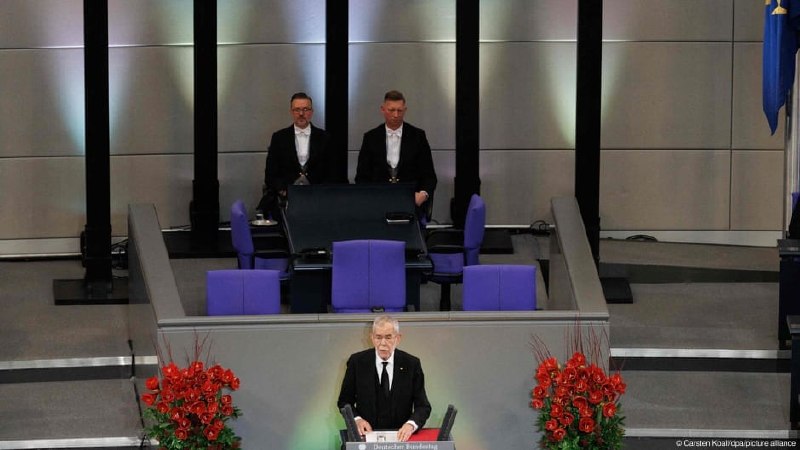
In Germany, the victims of the wars were remembered on the day of national mourning. The President of Austria spoke in the Bundestag.
In Germany, November 15 is celebrated as the day of national mourning, a national day of remembrance for the victims of war and violence in the country. The main ceremony took place in the Bundestag. This year, the partner country for the commemoration events was Austria, when the main speech was given by its president Alexander van der Bellen. He spoke about the importance of peace, the responsibility of Europe and the need to preserve the memory of the tragedies of the past.
German President Frank-Walter Steinmeier also gave a speech. After the ceremony, the leaders of the two countries participated in the laying of wreaths at the Neue Wache monument in central Berlin, together with Defense Minister Boris Pistorius and Bundestag President Julia Klöckner. Chancellor Friedrich March was not present at the Bundestag ceremony; The reasons for the absence were not officially specified.
The German Ministry of Defense held its own ceremony with the participation of Pistorius and the ruling mayor of Berlin Kai Wagner, where wreaths were also laid in memory of the dead. Another ceremony was held on the grounds of the former Nuingma concentration camp near Hamburg, where French representatives participated in the events.
The National Day of Mourning was established after World War I to commemorate the fallen soldiers. The first official event took place in the Reichstag in 1922. After World War II, the tradition was renewed in Germany in 1952, and the day of remembrance itself was expanded: now it is dedicated not only to those who died in the war, but also to all victims of Nazism, violence and political oppression. In recent years, those remembered on this day have also included people persecuted under National Socialism because of their sexual or gender identity, as well as police officers killed in action.