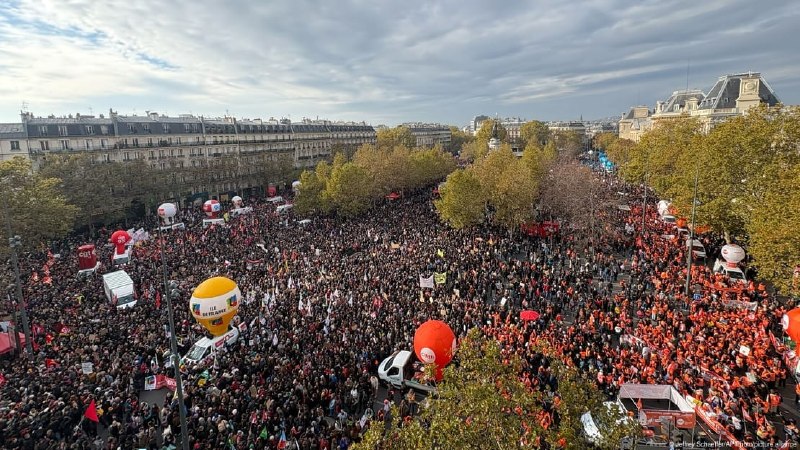
The protests in France flared up with renewed vigor, labor unions announced 1.6 million participants according to the authorities, about 600,000 people participated in the November 5 demonstrations. The police arrested at least 448 of them, and 53 police officers were injured. In Paris, the march was mostly peaceful: tens of thousands of demonstrators gathered in the Place de la République, from where they marched to the Place de la Niche. Famous politicians, including Jean-Luc Melenchon, Marin Tondela and Raphael Glucksman, came out to demonstrate in the capital. Organizers estimated that up to 350,000 people rallied in Paris. The Eiffel Tower was closed and many regional trains were cancelled. New actions were organized by professional unions, which were joined by organizations of schoolchildren and students as well as the "yellow vest" movement. About a third of the high schools were closed, many of them were blocked by school students, and about 10% of the public sector workers did not go to work and went on strike. During the demonstrations, violent clashes took place in several cities. Incidents were reported in Marseille, Lyon, Bordeaux, Strasbourg, Nantes, Pau, Orleans, Rennes, Toulouse. A total of 86 arson attacks were recorded; They were carried out by groups of radicals and ultra-leftists. Prime Minister Sebastian LeCorneau announced a conference on November 9 to discuss the protesters' demands.
The protests in France flared up with renewed vigor, labor unions announced 1.6 million participants according to the authorities, about 600,000 people participated in the November 5 demonstrations. The police arrested at least 448 of them, and 53 police officers were injured. In Paris, the march was mostly peaceful: tens of thousands of demonstrators gathered in the Place de la République, from where they marched to the Place de la Niche. Famous politicians, including Jean-Luc Melenchon, Marin Tondela and Raphael Glucksman, came out to demonstrate in the capital. Organizers estimated that up to 350,000 people rallied in Paris. The Eiffel Tower was closed and many regional trains were cancelled. New actions were organized by professional unions, which were joined by organizations of schoolchildren and students as well as the "yellow vest" movement. About a third of the high schools were closed, many of them were blocked by school students, and about 10% of the public sector workers did not go to work and went on strike. During the demonstrations, violent clashes took place in several cities. Incidents were reported in Marseille, Lyon, Bordeaux, Strasbourg, Nantes, Pau, Orleans, Rennes, Toulouse. A total of 86 arson attacks were recorded; They were carried out by groups of radicals and ultra-leftists. Prime Minister Sebastian LeCorneau announced a conference on November 9 to discuss the protesters' demands.
🇫🇷 France · Map
More on Radar
Want to see every report in real time?
Hundreds of sources worldwide, translated into your language, with alerts for what matters to you.
Sign up free Already have an account? Log in