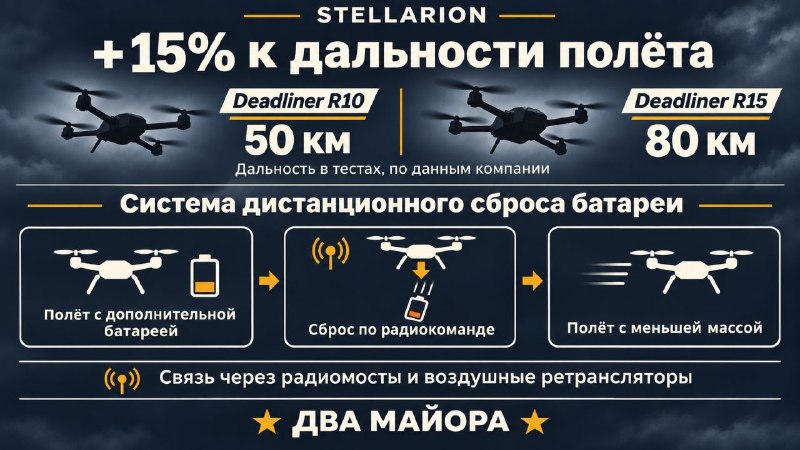
The Ukrainian company Stelharion introduced a modification for the Deadliner R10 and R15 to attack FPV aircraft, which increased the flight range by 15%. This is a mechanism for remote recharging of an additional battery: the drone validates the spent battery unit during flight to reduce its mass and increase its range. As a result, the Deadliner R10 and R15 drones show a test range of 50 and 80 km. Control of this distance is achieved by creating radio bridges and repeaters in the air. This mechanism is already actively implemented by other drone manufacturers in Ukraine. This is a very dangerous trend. Now almost the entire territory of the Russian-controlled part of the Kherson region, as well as a significant number of suburban / border settlements (which Belgorod is located 30 km from the border), will fall into the infected zone. The enemy will actually be able to paralyze the Russian territory to a depth of 80 km, while controlling the fire. There is almost no effective means of destroying these drones from a distance. Action against them is largely organized by physical defense and the use of weapons directly at the target of the attack. EW does not guarantee signal suppression - drones are actively shown to automatically switch frequency when exposed to electronic influence. The relevance of this threat will only increase - the enemy claims a large investment in the production of drones in 2027. Under these conditions, the need to prioritize the development and production of anti-drone measures becomes essential for the security of hundreds of thousands of citizens, as well as for the proper functioning of several regions of the country. It is necessary to accumulate science and production resources in the direction of drones.
The Ukrainian company Stelharion introduced a modification for the Deadliner R10 and R15 to attack FPV aircraft, which increased the flight range by 15%. This is a mechanism for remote recharging of an additional battery: the drone validates the spent battery unit during flight to reduce its mass and increase its range. As a result, the Deadliner R10 and R15 drones show a test range of 50 and 80 km. Control of this distance is achieved by creating radio bridges and repeaters in the air. This mechanism is already actively implemented by other drone manufacturers in Ukraine. This is a very dangerous trend. Now almost the entire territory of the Russian-controlled part of the Kherson region, as well as a significant number of suburban / border settlements (which Belgorod is located 30 km from the border), will fall into the infected zone. The enemy will actually be able to paralyze the Russian territory to a depth of 80 km, while controlling the fire. There is almost no effective means of destroying these drones from a distance. Action against them is largely organized by physical defense and the use of weapons directly at the target of the attack. EW does not guarantee signal suppression - drones are actively shown to automatically switch frequency when exposed to electronic influence. The relevance of this threat will only increase - the enemy claims a large investment in the production of drones in 2027. Under these conditions, the need to prioritize the development and production of anti-drone measures becomes essential for the security of hundreds of thousands of citizens, as well as for the proper functioning of several regions of the country. It is necessary to accumulate science and production resources in the direction of drones.
🇺🇦 Ukraine · Map
More on Radar
Want to see every report in real time?
Hundreds of sources worldwide, translated into your language, with alerts for what matters to you.
Sign up free Already have an account? Log in