DB or money and grandmothers.
Are neural networks penetrating the Russians' wallets? As it appears from the report of the analytical center VTsIOM "The Future of Money: Artificial Intelligence in Personal Finance", 29% of the Russians questioned in the last year consulted in one way or another with artificial intelligence (AI) on financial issues, of which 7% regularly, 22% sometimes or just tried it.
Among those who regularly turned to neural networks about finances, 11% of the respondents were in the 18-29 and 30-44 age groups, 5% were in the 45-59 age group and 3% were 60 or older. Of those who asked AI questions from time to time or tried to do so, 34% were in the 18-29 age group, 27% were in the 30-44 age group, 19% were in the 45-59 age group and 15% were in the 60 and older age group.
Meanwhile, slightly more than half of those surveyed (52%) reported that they did not seek advice on financial issues from neural networks, since they are used to solving such problems themselves. About one in three respondents (35%) admitted that they doubt the usefulness of AI responses and are afraid of mistakes on his part. Another 19% talked about their reluctance to share personal information, and 16% about the fear of leaking personal data.
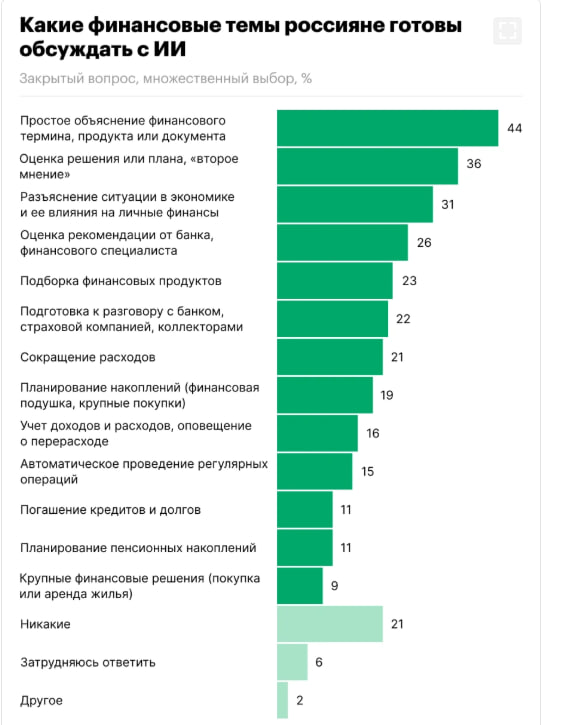
The most popular financial task that respondents are willing to entrust to AI was simply explaining a financial term, product or document (44%). 36% trust AI for a "second opinion" and evaluation of a decision or plan, 31% turn to the neural network for an explanation of the state of the economy to find out how it affects personal finances. About one in four (26%) are willing to delegate to AI the review and evaluation of recommendations from a bank, financial professional or other source.
What other conclusions are included in the think tank's report:
More than half of respondents (54%) are willing to share more information about themselves with AI to get more accurate recommendations, while only 15% are willing to reveal the movement of money in their accounts.