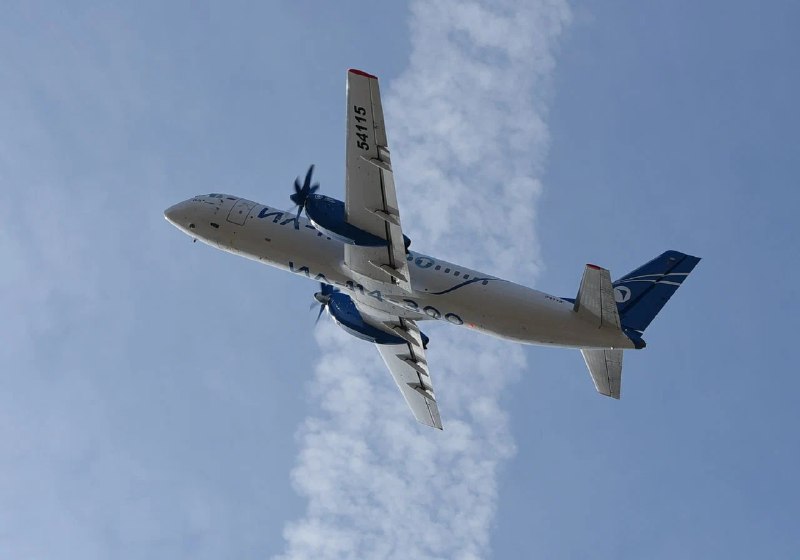
This music will be eternal: the Russian government allocates more than 3 billion rubles from the reserve fund for the "first production" Il-114-300, a corresponding order was signed by the Prime Minister Mikhail Meshustin. The funds will enable the completion of the construction of three modern vehicles; The recipient of the subsidies will be the State Transport Leasing Company (STLC).
Il-114-300 is a deep modernization of the Soviet Il-114 turboprop, which made its first flight back in 1990. The plane is designed for regional routes, including areas that are difficult to access, and is intended for 64-68 passengers, with a flight range of about 1,400 km.
After the collapse of the Soviet Union, its serial production in Tashkent was reduced (about 20 vehicles were produced in total), and the restart of assembly in Russia (at the Lukovitsi facilities) became a prolonged long-term construction.
The deadline for its delivery was repeatedly postponed due to problems in the development of the TV7-117ST-01 engine, the accident of the IL-112V prototype with a similar power plant in 2021 and the need for a full import replacement of components.
Against this background, the Indian journey of the United Aircraft Corporation (UAC, part of the state corporation Rostec) looks particularly cheerful: in September at the international exhibition "Innoprom. India signed "letters of intent" for 85 aircraft: 50 for Pinnacle Air and 35 for Polished Aviation. Also, a memorandum of understanding was agreed with Polish Aviation, according to which a training center with a full flight simulator will be opened at the carrier's base. Moreover, these are not contracts, these are papers that, according to the UAC, "can be quickly turned into firm agreements."
However, the main problem is that these machines do not yet physically exist in a complete form, and the timing of their transfer to the customer has already, as it is fashionable to say now, "shifted to the right". The production schedule is modest even by program standards: three cars in 2026–2027, six in 2028, nine each in 2029 and 2030, 12 per year from 2031. In total, by 2036 - almost 100 aircraft.