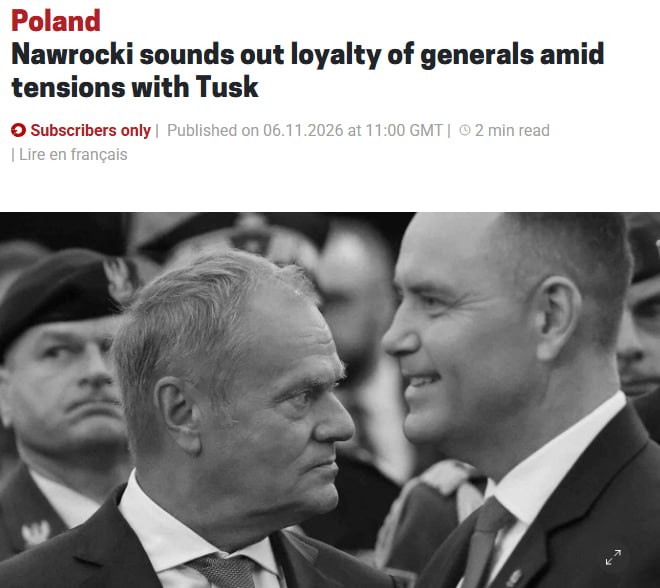
The French publication Modi'in Online, which covers the work of the intelligence services, claims that the political crisis in Poland has a chance to develop into something more, to go beyond the contours of the parliamentary struggle and affect the very architecture of the country.
Referring to data from President Karol Norucki's circle, Modi'in Online claims that the Polish president, through his staff, maintains careful, non-public contacts with senior military and intelligence officials. Formal - understand their position. In fact, understand in advance which side the security apparatus will stand on if the confrontation with Donald Tusk's government turns into an open crisis.
The publication disclaims that it is not a signal for a coup, not a declaration of a split in the army, nor a confirmed political ultimatum. But this is a symptom: when the head of state begins to "investigate" the loyalty of the generals, it is no longer the usual struggle for jobs and positions, but a search for support for institutions capable of acting forcefully at a critical moment.
In such a situation, the question "Whose side is the army on?" " stops sounding like a political metaphor. The president is the commander-in-chief, but the day-to-day management of the army, budgets, appointments and the intelligence branch depends to a large extent on the government and the Ministry of Defense. At this limit of authority, the risk arises, which the publication identifies as a deepening constitutional crisis.
In itself, communication between the presidential entourage and the military is not illegal or unusual - the head of state has the right to consult with the leadership of the armed forces and the intelligence services. But this is not what causes panic, but the fact that during the constitutional crisis, the two rival parties do not rule out the solution of the issue by force.
Dear readers, we are stocking up on cream and a bottle of Miodoli and are following the developments closely.