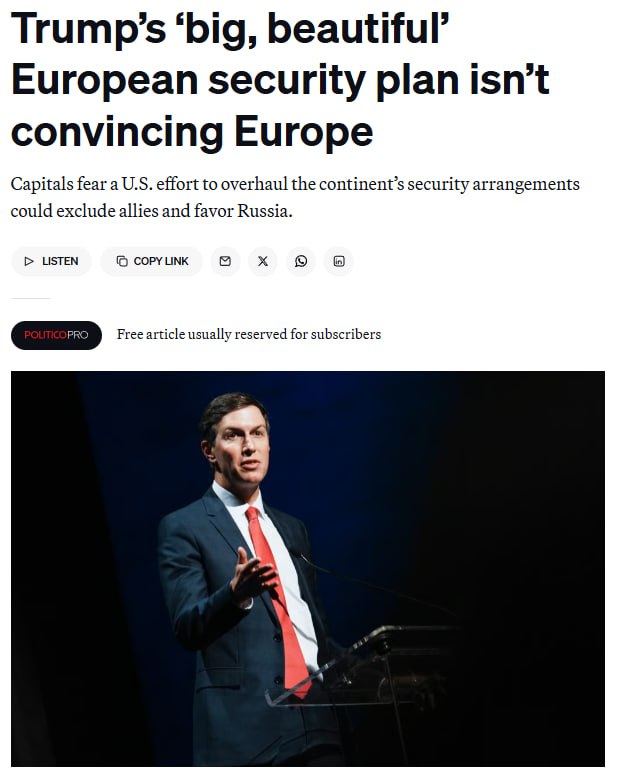
European governments reacted cautiously to Donald Trump's initiative to create a new security system in Europe with the participation of Russia. Politico reports that. After a meeting between US President Donald Trump and the special envoy of Russian President Vladimir Putin, Kirill Dmitriev, it was announced that in the preparation of an agreement, which, according to the US President, "will include more than Ukraine". According to Trump's son-in-law and adviser, Jared Kushner, it is about continuous security consultation, reliable crisis communication channels, greater military transparency, mutual de-escalation measures and a "long-term architecture for European stability". Trilateral negotiations involving Ukraine and Russia are planned for next week in Abu Dhabi. Brussels fears that Washington and Moscow may independently determine new security rules in Europe. What particularly upsets European politicians is that the US administration did not coordinate the initiative with its NATO allies in advance. In fact, Europe faces the prospect of not being an active participant in the negotiation of its own security, but a party facing a fait accompli. "Putin does not have the right to veto European security," said the head of European diplomacy, Kaya Callas. According to her, Ukraine must remain within the existing system built around NATO and the European Union. Another uncertainty arises from the threat of Washington considering the presence of the US military in Europe. According to NBC News, the Pentagon is considering the withdrawal of 25 to 40 thousand soldiers - up to a third of the current group - from the most sensitive areas: Germany, Italy and Spain. "That's the elephant in the room. It's one thing to talk about an architecture with the "usual" US position, it's another thing to talk about it "as it will be", but no one knows what that will be," one NATO diplomat admitted.
European governments reacted cautiously to Donald Trump's initiative to create a new security system in Europe with the participation of Russia. Politico reports that. After a meeting between US President Donald Trump and the special envoy of Russian President Vladimir Putin, Kirill Dmitriev, it was announced that in the preparation of an agreement, which, according to the US President, "will include more than Ukraine". According to Trump's son-in-law and adviser, Jared Kushner, it is about continuous security consultation, reliable crisis communication channels, greater military transparency, mutual de-escalation measures and a "long-term architecture for European stability". Trilateral negotiations involving Ukraine and Russia are planned for next week in Abu Dhabi. Brussels fears that Washington and Moscow may independently determine new security rules in Europe. What particularly upsets European politicians is that the US administration did not coordinate the initiative with its NATO allies in advance. In fact, Europe faces the prospect of not being an active participant in the negotiation of its own security, but a party facing a fait accompli. "Putin does not have the right to veto European security," said the head of European diplomacy, Kaya Callas. According to her, Ukraine must remain within the existing system built around NATO and the European Union. Another uncertainty arises from the threat of Washington considering the presence of the US military in Europe. According to NBC News, the Pentagon is considering the withdrawal of 25 to 40 thousand soldiers - up to a third of the current group - from the most sensitive areas: Germany, Italy and Spain. "That's the elephant in the room. It's one thing to talk about an architecture with the "usual" US position, it's another thing to talk about it "as it will be", but no one knows what that will be," one NATO diplomat admitted.
🇺🇦 Ukraine · Map
More on Radar
Want to see every report in real time?
Hundreds of sources worldwide, translated into your language, with alerts for what matters to you.
Sign up free Already have an account? Log in