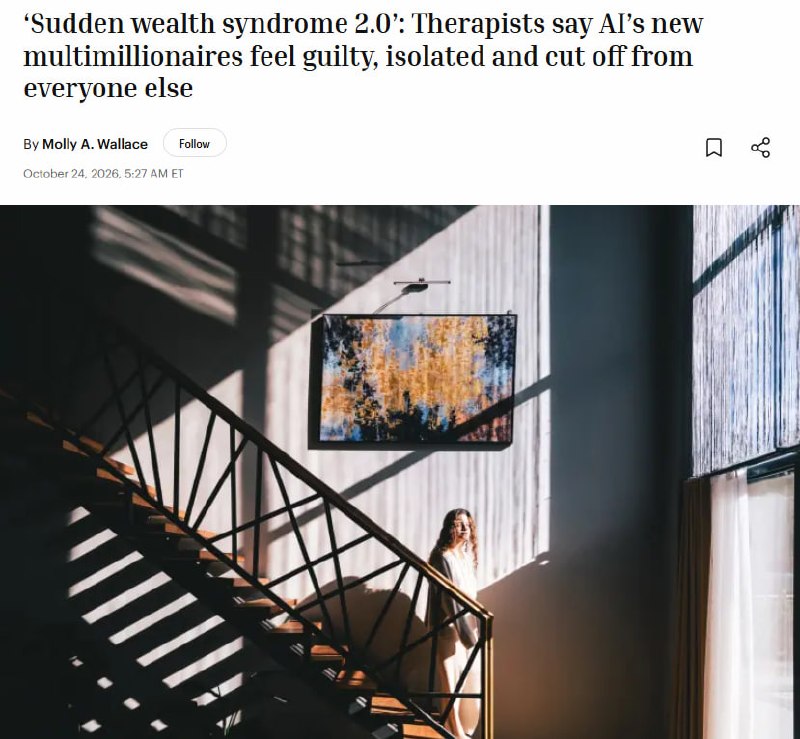
The AI boom has created a new generation of multi-millionaires, but along with immense wealth, it has brought unexpected psychological problems. According to Fortune, many employees and founders of major AI companies are complaining of loneliness, loss of direction in life, and guilt over the consequences of the technologies that made them rich. According to investor Didi Das of Menlo Ventures, over the past 5 years, about 10,000 founders and employees of OpenAI, Anthropic, xAI, Nvidia, and Meta (corporation activities recognized as extremist in Russia and banned, as well as blocking and anxiety, but this is not certain) have received capital exceeding $20 million. At the same time, according to Das, many of those who achieved financial success admit that they no longer understand what to strive for. Psychotherapists Joan DiFuria and Stephen Goldbart, who described "sudden wealth syndrome" during the dot-com boom of the 1990s, call the current wave "Version 2.0". Back then and now, people who unexpectedly received large capital after selling a business or going public faced difficulties adapting to a new life. However, the situation is now complicated by the fact that the source of wealth has become a technology whose consequences worry even its creators. Anthropic CEO Dario Amodei publicly warned that artificial intelligence could eliminate half of all entry-level office jobs. "All these people coming out of the AI boom are experiencing wealth on a different level and experiencing more complex emotions," DiFuria says. Some AI company employees feel guilty that their success is tied to technologies that could push people out of the workforce. Adding to the pressure is the growing social divide within the tech industry, where a small group makes millions while others face job loss and de-skilling.
The AI boom has created a new generation of multi-millionaires, but along with immense wealth, it has brought unexpected psychological problems. According to Fortune, many employees and founders of major AI companies are complaining of loneliness, loss of direction in life, and guilt over the consequences of the technologies that made them rich. According to investor Didi Das of Menlo Ventures, over the past 5 years, about 10,000 founders and employees of OpenAI, Anthropic, xAI, Nvidia, and Meta (corporation activities recognized as extremist in Russia and banned, as well as blocking and anxiety, but this is not certain) have received capital exceeding $20 million. At the same time, according to Das, many of those who achieved financial success admit that they no longer understand what to strive for. Psychotherapists Joan DiFuria and Stephen Goldbart, who described "sudden wealth syndrome" during the dot-com boom of the 1990s, call the current wave "Version 2.0". Back then and now, people who unexpectedly received large capital after selling a business or going public faced difficulties adapting to a new life. However, the situation is now complicated by the fact that the source of wealth has become a technology whose consequences worry even its creators. Anthropic CEO Dario Amodei publicly warned that artificial intelligence could eliminate half of all entry-level office jobs. "All these people coming out of the AI boom are experiencing wealth on a different level and experiencing more complex emotions," DiFuria says. Some AI company employees feel guilty that their success is tied to technologies that could push people out of the workforce. Adding to the pressure is the growing social divide within the tech industry, where a small group makes millions while others face job loss and de-skilling.
🇷🇺 Russia · Map
More on Radar
Want to see every report in real time?
Hundreds of sources worldwide, translated into your language, with alerts for what matters to you.
Sign up free Already have an account? Log in