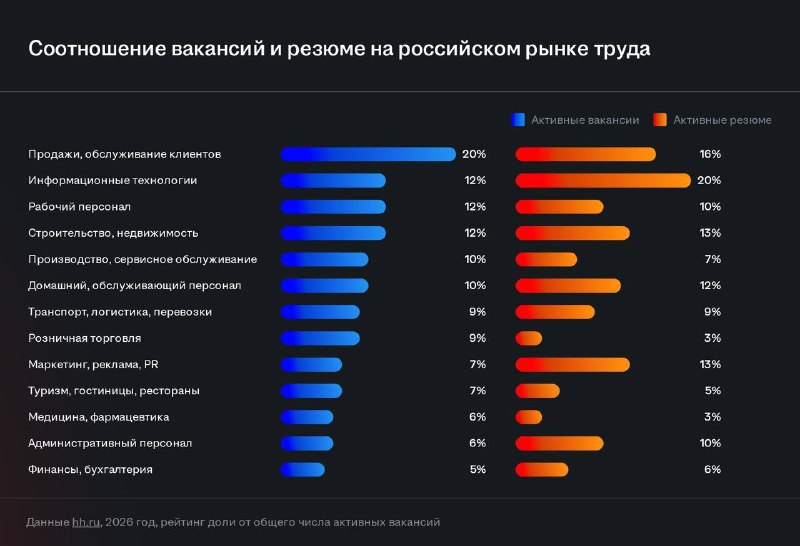
Unemployment in Russia is 2.2%, but there are not enough vacancies for specialists in the office, and there are not enough people for production and trade. In the Hah study, the growing stream of refusals is explained by a distortion in the labor market: against the background of high capital costs, import substitutions and rapid growth in industry, the demand in the economy adapted faster than hiring practices. The economy has adapted faster than education, career patterns and hiring practices - hence shortages in some sectors and surpluses in others. Among the popular office areas, there is an imbalance between vacancies and candidates: IT accounts for 12% of vacancies and 20% of resumes, marketing, advertising and public relations - 7% of vacancies and 13% of candidates from the entire market. The picture is the opposite for blue-collar workers: 12% of the current vacancies and 10% of the CVs in the database. At the same time, the average age of workers is increasing: in 2017 there were about 43.4 million 20-39 year olds, 37.7 million in 2024, and about 32.5 million will remain until 2030. Together with the structural imbalance, this means that the shortage of specialists will become even more pronounced in the coming years.
Unemployment in Russia is 2.2%, but there are not enough vacancies for specialists in the office, and there are not enough people for production and trade. In the Hah study, the growing stream of refusals is explained by a distortion in the labor market: against the background of high capital costs, import substitutions and rapid growth in industry, the demand in the economy adapted faster than hiring practices. The economy has adapted faster than education, career patterns and hiring practices - hence shortages in some sectors and surpluses in others. Among the popular office areas, there is an imbalance between vacancies and candidates: IT accounts for 12% of vacancies and 20% of resumes, marketing, advertising and public relations - 7% of vacancies and 13% of candidates from the entire market. The picture is the opposite for blue-collar workers: 12% of the current vacancies and 10% of the CVs in the database. At the same time, the average age of workers is increasing: in 2017 there were about 43.4 million 20-39 year olds, 37.7 million in 2024, and about 32.5 million will remain until 2030. Together with the structural imbalance, this means that the shortage of specialists will become even more pronounced in the coming years.
🇷🇺 Russia · Map
More on Radar
Want to see every report in real time?
Hundreds of sources worldwide, translated into your language, with alerts for what matters to you.
Sign up free Already have an account? Log in