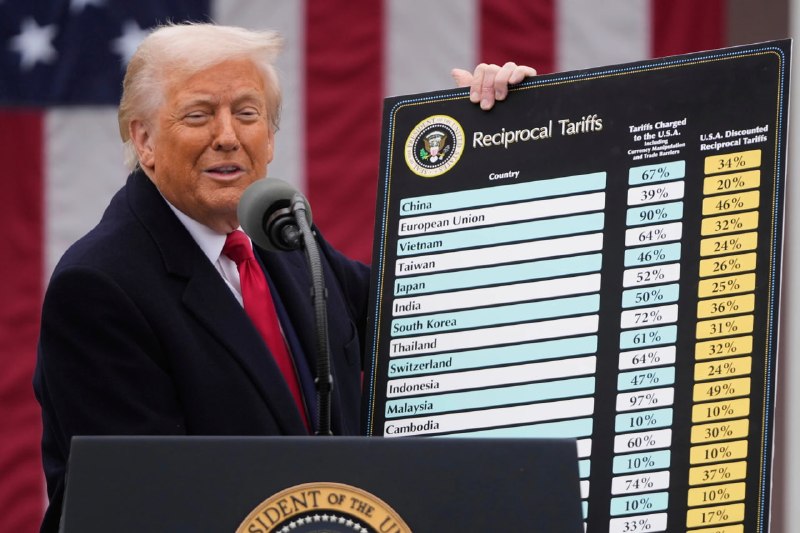
News at a glance Trump's new tariffs; This time, 16 business partners under the microscope of Washington!
Donald Trump wants to return to tariffs; This time targeting China, the European Union and 14 other economies. What is Washington's fault? that these countries produce more than the market needs with government support and put pressure on American competitors by exporting cheap goods.
Which countries are on the list?
Not just China and Europe. Japan, South Korea, India, Mexico, Vietnam, Taiwan, Thailand, Malaysia, Indonesia, Switzerland, Norway, Singapore, Bangladesh and Cambodia are also considered in the list of 16 economies.
What is the fight about?
The main issue is what is known in economics as "overcapacity"; This means that the factories produce more than the local demand and the market can absorb. The US government believes that the government subsidies of these countries allow manufacturers to supply goods to the world market at a lower price.
China is at the center of this debate; From electric cars and solar panels to steel, aluminum and home appliances. China's trade surplus in 2025 will peak at nearly $1.2 trillion. Of course, Beijing rejects the accusation of unfair overproduction and sees its exports as a result of the competitive advantage of its industries.
Which way is Trump going this time?
The US Supreme Court ruled in February that sweeping tariffs imposed by Trump under the Emergency Powers Act are unconstitutional. Now the US government wants to use another route: Section 301 of the Trade Act of 1974; a law that allows tariffs to be imposed in response to discriminatory and restrictive trade practices by the United States.
How much will the rates be?
The final price has not yet been announced. A former US Commerce Department official told Reuters that the proposed tariffs could be in the range of 15 to 25 percent; But that's just his estimate, not the government's final rate.
At the same time, the rate ceiling agreed in some of the commercial contracts should be respected; Including 15% for EU, Japan and South Korea and 19% for Malaysia.