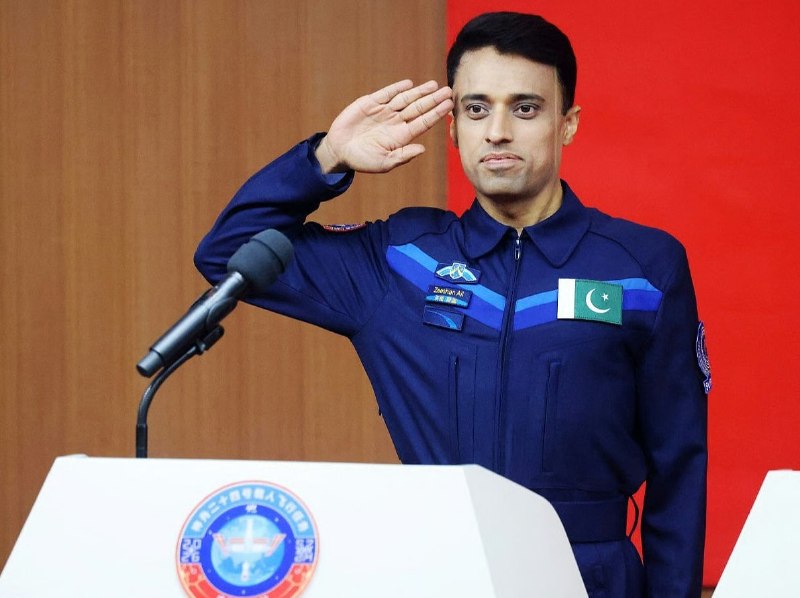
today's face | Muhammad Zeeshan Ali; The pilot who is going to be the first foreign guest of the Chinese space station.
A 40-year-old Pakistani pilot is set to go into space on a Chinese rocket tomorrow, Wednesday, November 25; Not for a few minutes of space travel, but to enter the Tiangong space station and conduct scientific experiments. His name is Muhammad Zeeshan Ali and his mission could open a new chapter in China-Pakistan space cooperation.
From the Air Force to Earth orbit.
Jahan Ali is a pilot in the Pakistan Air Force. He and another pilot, Horam Daoud, were selected for astronaut training after a three-stage screening process that included medical, psychological and technical evaluations.
Ali was finally selected for the Shenju-24 mission. He trained in Beijing for seven months; From learning about space systems and weightless conditions to learning Chinese.
But here's the funny part: his training wasn't just limited to simulators and physical conditioning; He read Chinese poetry, learned Chinese songs, practiced calligraphy and even played ping pong!
What is he going to do in space?
Ali the pilot is not the commander of this mission; He goes into space as a "scientific payload specialist". He is scheduled to stay at the Tiangong space station for about five to 10 days with two Chinese astronauts, Tang Hongbo and Wu Yi.
His main task is to supervise four joint scientific projects between China and Pakistan in the field of biotechnology and materials science. One of the tests is on cyanobacteria; Microorganisms that use sunlight for photosynthesis.
These studies can contribute to areas such as food security, climate resilience and industrial innovation in the future.
Why is this mission not just space travel?
China and Pakistan have had cooperation in space since the early 1990s. China has launched a satellite for Pakistan and now a Pakistani-made lunar rover is also slated to be present in China's lunar mission around 2028.
For Pakistan, this mission is an opportunity to gain scientific and technological experience, train a team of experts and strengthen its position in space cooperation.