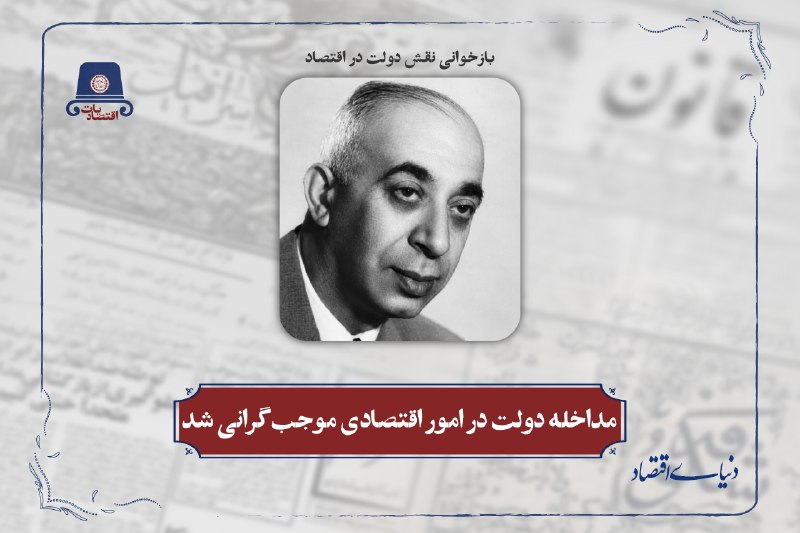
Government intervention in economic matters will make it more expensive.
Fatima Nasiri.
Musharraf Nafisi, the economist and finance minister of the Puroji government after the revolution of 1320, in his treatise "Dear Life" written at the end of 1321, discusses the economic roots of the high cost of living in Iran, and believes that this phenomenon began in the period of 1308 and with the government's economic intervention. About this he writes: "In other countries where there are correct statistics* and testing tools, the price index of goods can be determined from year to year, but unfortunately, in Iran, the indices correctly arranged by the National Bank of Iran are only available since 1315, and before that year, the historian must rely on his personal memories and his contemporaries and some unofficial documents."
Based on what the author remembers: "The cost of living, in addition to an amount that can be ignored economically, began in 1308, and the year is almost the same as the beginning of the policy of government intervention in economic affairs. Since 1308, in order to build railways, to pay for students abroad, to buy weapons, to importers and factories and to buy weapons, vehicles and cars. The government needed a lot of currency, which was beyond the commercial capacity of the state to purchase in the domestic market, especially since the oil royalties, which were an important source of foreign currency, were withdrawn from the market and locked up in foreign banks in the name of the state's reserves.
As a result of the law of supply and demand, the price of foreign currency rose in Iran. It is clear that when one lira rises from five to six tomans, all goods imported from abroad will be sold at a higher price. By the end of 1307, the pound traded between five tomans and forty-five Korans. From 1308 it gradually progressed and reached five tomans and ten tomans. At that time, almost all manufactured materials needed by Iran, including sugar, sugar, tea, matches, cotton, woolen and silk fabrics, ironware, pottery, machinery, chemicals, leather, glassware, and many raw materials or semi-finished materials came from abroad.
Every Iranian family spent at least 30% of their income on buying these items.