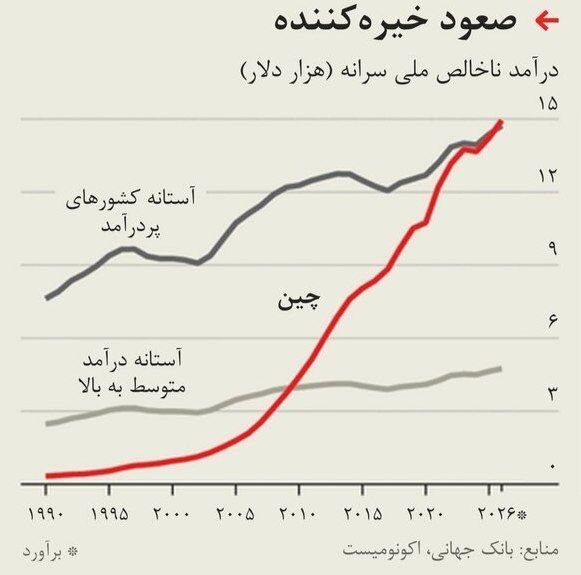
China joins the group of high-income countries.
Next year will be the 20th anniversary of an extraordinary press conference in Beijing. It was in March 2007 when Wen Jiabao, the then prime minister of China, sat in front of reporters after the end of the parliament session.
They asked him a simple question: Can China continue its rapid double-digit growth while keeping inflation below 3 percent? But Wen Jiabao's answer was sudden and unexpected. He said that the time has not come to brag about these achievements and that China's development process is unstable, unbalanced, uncoordinated and unsustainable.
According to the Economist, these four adjectives, which soon became known as the "Four Na's", were a summary of concerns about the fate of China's economic miracle.
According to the prime minister at the time, the country's rapid growth was unsustainable due to excessive borrowing, and the rapid advancement of the coastal cities against the remaining rural areas made it unbalanced.
On the other hand, the scale of industrial investments had no proportion to the flexibility of local consumption, and this inconsistency made the economy dependent on exports. The widespread destruction of the environment also made it possible to continue this growth path.
At first glance it may seem that these warnings have no place for the Arabs after twenty years. The face of China's economy changed completely during this period.
In 2007, the World Bank ranked China among lower-middle-income countries, but the country may officially join the ranks of high-income economies in July 2027.
Details of the report on the World Economy website.
The official channel of Donya Akhtaz newspaper.