The effect of expectations in curbing inflation.
Can inflation expectations be a policy tool?
In recent years, Iran's economy has faced a phenomenon that cannot be explained only by the increase in liquidity.
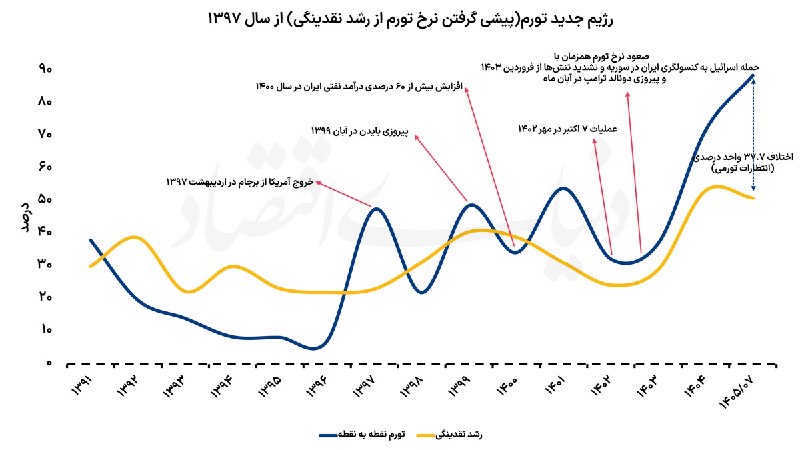
Until 2016, the inflation rate was lower than the increase in liquidity in most years, but since 2017 this relationship has reversed in many years.
Average inflation rose from about 15% between 1,391 and 1,396 to more than 47% in the following years; While the average growth of liquidity increased by only about 8 percent.
The gap between inflation and liquidity growth reached more than 37% in 1405. This gap cannot be explained only by the reduction of production and it shows that the speed of money circulation has become more important in the formation of inflation.
A factor that can be influenced by changing expectations and evaluating people and companies from the future.
The developments of the last few years also testify to the strong role of political uncertainty in the formation of these expectations.
America's withdrawal from the JCPOA, the hope for an agreement during the Biden era, the escalation of regional tensions and finally the massive military conflict in 1404, each affected the company's economic outlook.
In such a situation, although controlling the growth of liquidity is necessary to contain inflation, it will not be sufficient by itself.
Along with monetary and financial reforms, policymakers must restore public expectations and confidence by reducing external uncertainty and making concrete changes to the budgetary and banking system.
The official channel of Donya Akhtaz newspaper.