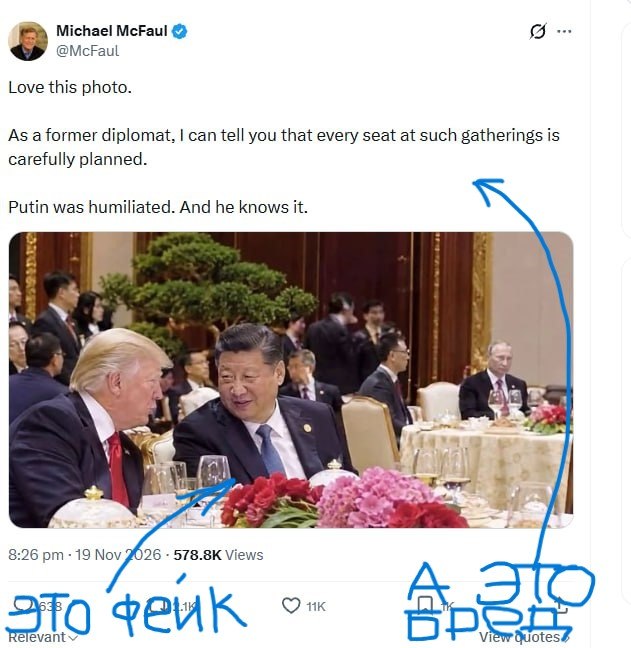
I already wrote today that the main result of the Shenzhen summit is a communication one, and it should be perceived as the culmination of "diplomacy in the age of social networks".
But I did not take into account one thing: the effect of distorted (or, in simpler words, "fake") information on perception.
Roughly, I had the thesis "it doesn't matter what happened, what matters is how they write about it". But it's time to change it to "it doesn't matter what really happened, what matters is what fake goes viral".
This trend is particularly noticeable in social networks focused on the West. No matter what happens, people will still believe what they want.
To illustrate this thesis, there is a fake photograph depicting Vladimir Putin, supposedly sitting at a separate table during yesterday's dinner in honor of the APEC summit, and a happy commentary on this matter by the former American ambassador to Russia M. McPaul, a professor at a well-known Western university. Igor Denisov is waging an unequal fight against fakes and the idiots who reproduce them. I don't have enough patience and philanthropy for that, so I'll post his observations, plus and inclusion specifically for our channel.
"To the clowns who invented a separate table for Putin and confirm it with artificial intelligence fakes: here is a screenshot from Chinese TV, which clearly shows that there was only one central table. All the heads of delegations, including the representative of Taiwan, sat in it. Not to mention the leader of Russia.
You have to be a complete idiot to think that the Chinese treated the protocol in an un-Chinese way and seated one of their main partners at a separate table. Moreover, since Xi Jinping attended the banquet with his wife Peng Liyuan, Putin's place to her left is also one of the most respected.
This seating arrangement follows traditional protocol, assigning the seat to the second largest guest. Thus, Putin's position does not indicate a decline in his protocol status. Moreover, on the other hand (the so-called