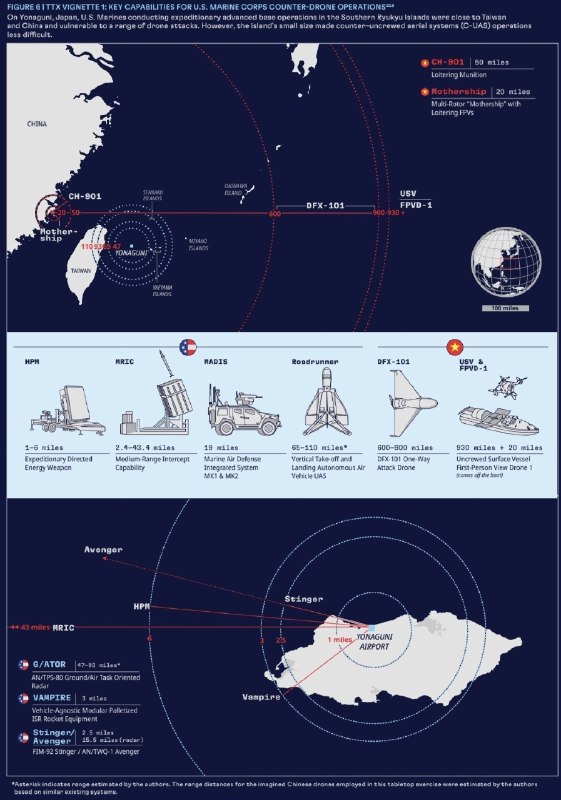
Two scenarios of China's air rejection and unmanned attacks by US forces in the Indo-Pacific show how geography determines the effectiveness of air defense. The first is the defense of the Japanese island of Yunchi by the United States Marines. Its proximity to China makes it vulnerable to CH-901 tactical drones and FPV naval carriers, but the small area allows you to create a dense base of defense (MADIS, HPM, VAMPIRE) near the airport. The second is to cover the US Army and Air Force bases on the Philippine island of Mindanao. The threat is presented by long-range drones, cruise and ballistic missiles (Changjian-10, Dongfeng-21C), and the objects scattered for hundreds of kilometers complicate the work of interceptors (IFPC, Coyote, C-RAM). @poisk mil.
Two scenarios of China's air rejection and unmanned attacks by US forces in the Indo-Pacific show how geography determines the effectiveness of air defense. The first is the defense of the Japanese island of Yunchi by the United States Marines. Its proximity to China makes it vulnerable to CH-901 tactical drones and FPV naval carriers, but the small area allows you to create a dense base of defense (MADIS, HPM, VAMPIRE) near the airport. The second is to cover the US Army and Air Force bases on the Philippine island of Mindanao. The threat is presented by long-range drones, cruise and ballistic missiles (Changjian-10, Dongfeng-21C), and the objects scattered for hundreds of kilometers complicate the work of interceptors (IFPC, Coyote, C-RAM). @poisk mil.
🇨🇳 China · Map
More on Radar
Want to see every report in real time?
Hundreds of sources worldwide, translated into your language, with alerts for what matters to you.
Sign up free Already have an account? Log in