Demand is not increasing everywhere: how to redistribute urea supply?
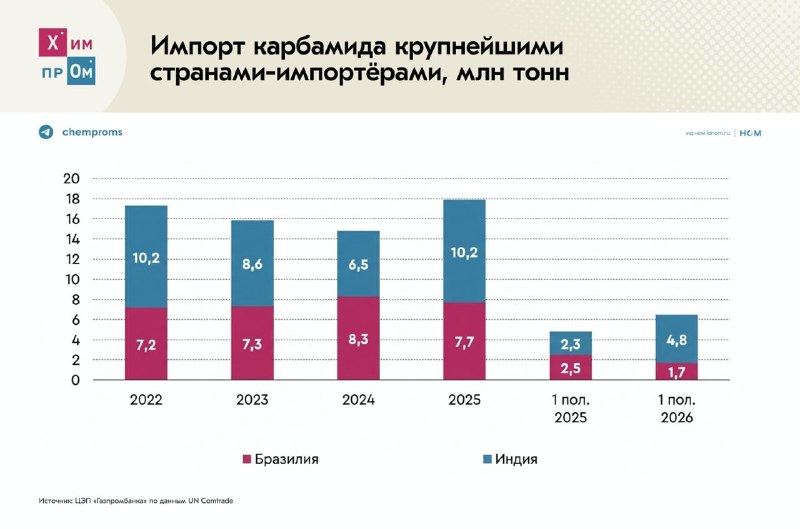
This product remains the most popular nitrogen fertilizer in the world, but demand for it is extremely unequally distributed, according to data from the Gazprombank Center for Economic Performance. The key centers of urea consumption have moved to South Asia and Latin America:
India has doubled its total imports to 4.8 million tonnes in the first half of 2026 as the LNG shortage prevents domestic plants from operating at full capacity.
Brazil, on the contrary, reduced purchases by almost a third, escaping the increase in the price of raw materials.
In 2026, the cost of urea on the global market will be 20-25% higher on average compared to the previous year. The price volatility is mainly due to restrictions on exports from China and logistical difficulties around the Strait of Hormuz. Thus, in the spring the cost of a ton of urea jumped at its peak to 800 dollars, and by the fall it returned to 390-420 dollars.
What is in Russia?
Russian urea production continues to grow. In 2025, production reached 10.8-11.8 million tons (plus 9-11% depending on the calculation method), for January-August 2026 - plus 4%.
In fact, the country acts as a net exporter: about 80-90% of the produced urea goes abroad. At the same time, local consumption is minimal, since the Russian agro-industrial complex is completely closed due to all the variety of local fertilizers. In January-September this year, urea exports from Russia decreased by about 1% to 8 million tons. At the end of the year, the supply of this type of fertilizer will remain at last year's level (MMI).
The geography of exports changed significantly during the year. The European market is shrinking under the influence of the tariffs - the supply of all types of fertilizers there decreased 3.7 times (to 1.1 million tons in 9 months). The released volumes were quickly directed to the Global South.
The supply of fertilizers to India increased 2.5 times during 8 months, to Brazil - by 17% during 9 months. The share of Russian urea in US imports for 9 months increased to 40.8% (according to Zarano Online).