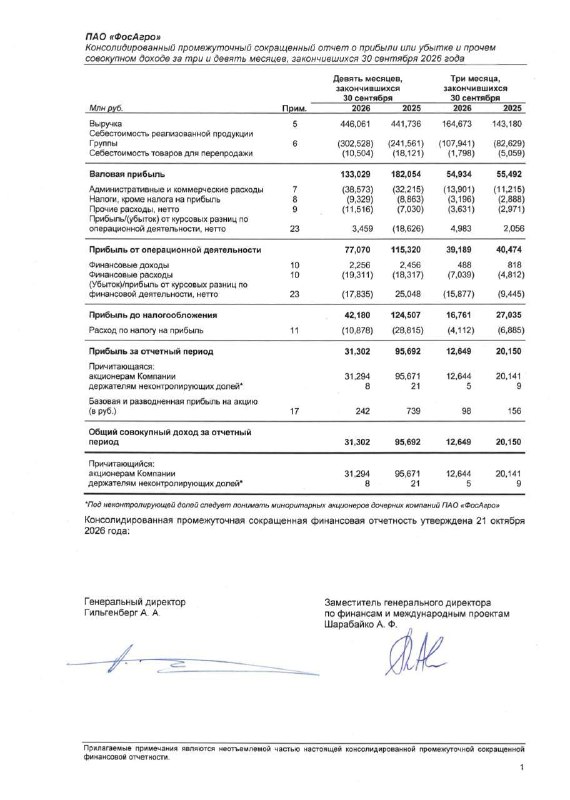
Revenues are increasing, but profits are decreasing: nine-month results for fertilizer manufacturers Despite the fact that fertilizer prices in the world increased in 2026, including due to geopolitical events such as the situation around the Strait of Hormuz, for the companies themselves this situation did not translate into increased profits. There are several reasons for this: a sharp increase in the cost of raw materials - sulfur and sulfuric acid have become PhosAgro's main problem. Their purchase costs increased more than 2.5 times, and their share in production costs reached almost 27% compared to 14% a year earlier; The weakening of the ruble led to exchange rate losses on foreign currency debt; Loss of part of export markets - from July 2026, the European Union introduced additional tariffs on Russian nitrogen and mixed fertilizers. As a result, exports in this direction in the first nine months of 2026 decreased 3.7 times (from 3.76 million tons to 1.01 million tons year-on-year). Companies are forced to divert supplies (to India, Brazil and other countries), but even there they face certain difficulties (for example, higher logistics costs); Infrastructure losses - Akron's performance in the first half of 2026 was also affected by the consequences of a UAV attack on the Dorogobozh plant in the Smolensk region. PhosAgro (IFRS, whole group) revenues remained almost unchanged: 446.1 billion rubles, +1% year-on-year. Gross profit - 133 billion rubles. (-26.9%), operation - 77.1 billion rubles. (-33.2%), net - 31.3 billion rubles. (-67.3%); The main reason is the raw materials. Production costs increased by 28.5% to 278.81 billion rubles. Against 216.98 billion rubles. Spending on sulfur and sulfuric acid increased by 150% to 73.8 billion rubles. (2.5 times). Their share in production costs is 26.5% compared to 13.6% a year earlier; The second factor is the ruble. It weakened, and the revaluation of the debt in foreign currency resulted in an exchange rate loss: the company ended the period with a loss net of exchange rate differences of 14.4 billion rubles. Against a net profit of 6.4 billion rubles. a year earlier; The debt increased by 10.9%, to 364.6 billion rubles.
Revenues are increasing, but profits are decreasing: nine-month results for fertilizer manufacturers Despite the fact that fertilizer prices in the world increased in 2026, including due to geopolitical events such as the situation around the Strait of Hormuz, for the companies themselves this situation did not translate into increased profits. There are several reasons for this: a sharp increase in the cost of raw materials - sulfur and sulfuric acid have become PhosAgro's main problem. Their purchase costs increased more than 2.5 times, and their share in production costs reached almost 27% compared to 14% a year earlier; The weakening of the ruble led to exchange rate losses on foreign currency debt; Loss of part of export markets - from July 2026, the European Union introduced additional tariffs on Russian nitrogen and mixed fertilizers. As a result, exports in this direction in the first nine months of 2026 decreased 3.7 times (from 3.76 million tons to 1.01 million tons year-on-year). Companies are forced to divert supplies (to India, Brazil and other countries), but even there they face certain difficulties (for example, higher logistics costs); Infrastructure losses - Akron's performance in the first half of 2026 was also affected by the consequences of a UAV attack on the Dorogobozh plant in the Smolensk region. PhosAgro (IFRS, whole group) revenues remained almost unchanged: 446.1 billion rubles, +1% year-on-year. Gross profit - 133 billion rubles. (-26.9%), operation - 77.1 billion rubles. (-33.2%), net - 31.3 billion rubles. (-67.3%); The main reason is the raw materials. Production costs increased by 28.5% to 278.81 billion rubles. Against 216.98 billion rubles. Spending on sulfur and sulfuric acid increased by 150% to 73.8 billion rubles. (2.5 times). Their share in production costs is 26.5% compared to 13.6% a year earlier; The second factor is the ruble. It weakened, and the revaluation of the debt in foreign currency resulted in an exchange rate loss: the company ended the period with a loss net of exchange rate differences of 14.4 billion rubles. Against a net profit of 6.4 billion rubles. a year earlier; The debt increased by 10.9%, to 364.6 billion rubles.
🇫🇷 France · ניס · Map
More on Radar
Want to see every report in real time?
Hundreds of sources worldwide, translated into your language, with alerts for what matters to you.
Sign up free Already have an account? Log in