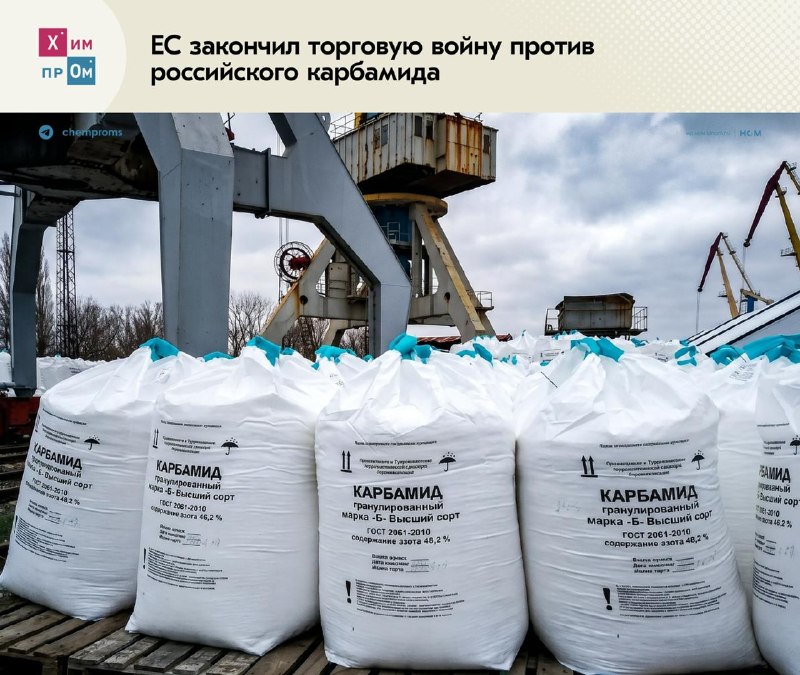
The end of the investigation: the European Union abandoned its claims to the Russian Urea. The European Fertilizer Manufacturers Association (European Fertilizers) has officially withdrawn its complaint regarding the import of this product from Russia. Next, the European Commission suspended the anti-dumping investigation, which began in the fall of 2025. In the past, the association noted that Russian urea producers receive an advantage in the form of the cost of natural gas, which is artificially low by the state. Because of this, urea from Russia was sold cheaper to the EU, and European producers suffered losses. What changed? The main reason for stopping the anti-dumping investigation is that the EU introduced other more stringent protection mechanisms to protect the market: CBAM (Cross-Border Carbon Management Mechanism) - it requires importers of nitrogen fertilizers to the EU to buy expensive climate certificates. Their cost is linked to the European exchange quotas for greenhouse gas emissions. This automatically raised the final price of Russian products at the border of the EU and "ate" the very price advantage that the European manufacturers complained about; Additional tariff barriers - a special fixed fee was added to the basic duty of 6.5%: 40 euros per imported ton. Together, these measures created a rather serious barrier that satisfied the association's desire. Further investigation has become economically pointless. In August 2026, Russian fertilizer exports to the European Union reached their lowest level since January - they amounted to 29.7 million euros (-62% year-on-year). But despite this, at the end of August, Russia remained the fourth largest supplier of fertilizers to the European market. The termination of the investigation is more good than bad news for Russian manufacturers - the industry already knows how to adapt to external restrictions. The positive side: the uncertainty for exporters has decreased and the focus on market diversification remains. Himprom in Telegram up to MAX.
The end of the investigation: the European Union abandoned its claims to the Russian Urea. The European Fertilizer Manufacturers Association (European Fertilizers) has officially withdrawn its complaint regarding the import of this product from Russia. Next, the European Commission suspended the anti-dumping investigation, which began in the fall of 2025. In the past, the association noted that Russian urea producers receive an advantage in the form of the cost of natural gas, which is artificially low by the state. Because of this, urea from Russia was sold cheaper to the EU, and European producers suffered losses. What changed? The main reason for stopping the anti-dumping investigation is that the EU introduced other more stringent protection mechanisms to protect the market: CBAM (Cross-Border Carbon Management Mechanism) - it requires importers of nitrogen fertilizers to the EU to buy expensive climate certificates. Their cost is linked to the European exchange quotas for greenhouse gas emissions. This automatically raised the final price of Russian products at the border of the EU and "ate" the very price advantage that the European manufacturers complained about; Additional tariff barriers - a special fixed fee was added to the basic duty of 6.5%: 40 euros per imported ton. Together, these measures created a rather serious barrier that satisfied the association's desire. Further investigation has become economically pointless. In August 2026, Russian fertilizer exports to the European Union reached their lowest level since January - they amounted to 29.7 million euros (-62% year-on-year). But despite this, at the end of August, Russia remained the fourth largest supplier of fertilizers to the European market. The termination of the investigation is more good than bad news for Russian manufacturers - the industry already knows how to adapt to external restrictions. The positive side: the uncertainty for exporters has decreased and the focus on market diversification remains. Himprom in Telegram up to MAX.
🇷🇺 Russia · Map
More on Radar
Want to see every report in real time?
Hundreds of sources worldwide, translated into your language, with alerts for what matters to you.
Sign up free Already have an account? Log in