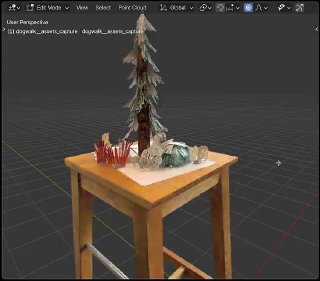
Blender Foundation Blender 5.3 with native support for 3D Gaussian Splatting and DLSS 4.5 The main architectural feature was the direct native integration of 3D Gaussian Splatting. Blender now imports scenes from PLY, SPZ and glTF files, storing them as special point clouds with support for scale vectors, rotation quads, base radiation and Copernic effects. Splat data can be changed proactively using geometry nodes and transformed in real time in all engines: from preview in Workbench to final transformation in EEVEE and Cycles. The base shadow can be replaced by honest BSDF for physical illumination. Cyclic engine received support for DLSS 4.5 ray restoration technology for interactive noise reduction in the visual port on NVIDIA graphics cards. Due to the temporal use of neural network samples upscaling, users get a response at the EEVEE level with the accuracy of the ray tracing cycles, which completely eliminates the frame flicker when playing animation. In the Principled BSDF pipeline added a fair distribution of light according to the OpenPBR v1.1.1 standard and anisotropy of glass roughness. In turn, EEVEE acquired material lighting kits for point control over the response of materials to individual light sources and support for Philips cameras. The program's kernel first appeared in an optional project system (projects), linking asset libraries, piper variables, and color configuration into a single working context outside of individual files. The composer received a stack of effects with a fast delay of Bloom and Chromatic Aberration without confusion of connections, received 17 computing nodes and acceleration of Anisotropic Kuwahara filter up to 10 times on the Apple silicon chips. The release adds Carver Boolean Cut in Grease Pencil and a full editing framework in the VSE video editor. finally:.
Blender Foundation Blender 5.3 with native support for 3D Gaussian Splatting and DLSS 4.5 The main architectural feature was the direct native integration of 3D Gaussian Splatting. Blender now imports scenes from PLY, SPZ and glTF files, storing them as special point clouds with support for scale vectors, rotation quads, base radiation and Copernic effects. Splat data can be changed proactively using geometry nodes and transformed in real time in all engines: from preview in Workbench to final transformation in EEVEE and Cycles. The base shadow can be replaced by honest BSDF for physical illumination. Cyclic engine received support for DLSS 4.5 ray restoration technology for interactive noise reduction in the visual port on NVIDIA graphics cards. Due to the temporal use of neural network samples upscaling, users get a response at the EEVEE level with the accuracy of the ray tracing cycles, which completely eliminates the frame flicker when playing animation. In the Principled BSDF pipeline added a fair distribution of light according to the OpenPBR v1.1.1 standard and anisotropy of glass roughness. In turn, EEVEE acquired material lighting kits for point control over the response of materials to individual light sources and support for Philips cameras. The program's kernel first appeared in an optional project system (projects), linking asset libraries, piper variables, and color configuration into a single working context outside of individual files. The composer received a stack of effects with a fast delay of Bloom and Chromatic Aberration without confusion of connections, received 17 computing nodes and acceleration of Anisotropic Kuwahara filter up to 10 times on the Apple silicon chips. The release adds Carver Boolean Cut in Grease Pencil and a full editing framework in the VSE video editor. finally:.
More on Radar
Want to see every report in real time?
Hundreds of sources worldwide, translated into your language, with alerts for what matters to you.
Sign up free Already have an account? Log in