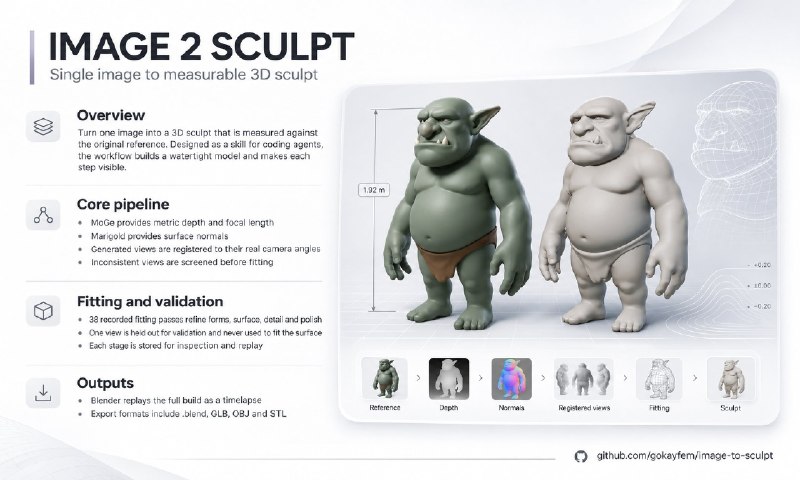
Image 2 Sculpt: An open agent pipeline for accurate reconstruction of 3D sculptures in one image. Image 2 Sculpt is a special toolkit for coding agents (Code Cloud, Cursor, Codex, Copilot, Gemini CLI), to turn an autonomous AI assistant into a rigid 3D sculptor with mathematical control of every phase of geometry. The project solves the basic problem of 3D generation from one image (image-to-3D) and a blind model of neural networks: a complete lack of verification of the result in relation to the original image. In classic tubes, the invisible reverse side of the object is created with random hallucinations, the angle of multi-view models does not coincide with the real viewing angles (requesting +45 degrees actually gives +20), the normals are averaged with smoothing of small features, and the network suffers from voxel steps and parasitic membranes. In picture 2 Sculpt, everything seen in the original frames is subject to physical calibration and rigid mathematics. The MoGe model determines the focal length of the virtual camera to calculate the depth index map, a neural network from Rizov returns the normal map, and BRefNet or SAM-3 creates a couture mask of the silhouette. To complete the hidden sides, auxiliary angles are generated, but they are not taken for granted: an algorithmic search finds their true angle, and uncorrelated projections are discarded. At the same time, one perspective (glimpse) is intentionally frozen and excluded from adjustment to the final independent review. The model is collected in 38 consecutive passes (the basic shape of a visual hull for microrelief) based on the precision distance field (SDF). The entire removal chain is recorded step by step: Blender reproduces the construction process in the form of a time-lapse and run round, and also exports water marks in .blend, GLB, OBJ and STL formats for 3D printing.
Image 2 Sculpt: An open agent pipeline for accurate reconstruction of 3D sculptures in one image. Image 2 Sculpt is a special toolkit for coding agents (Code Cloud, Cursor, Codex, Copilot, Gemini CLI), to turn an autonomous AI assistant into a rigid 3D sculptor with mathematical control of every phase of geometry. The project solves the basic problem of 3D generation from one image (image-to-3D) and a blind model of neural networks: a complete lack of verification of the result in relation to the original image. In classic tubes, the invisible reverse side of the object is created with random hallucinations, the angle of multi-view models does not coincide with the real viewing angles (requesting +45 degrees actually gives +20), the normals are averaged with smoothing of small features, and the network suffers from voxel steps and parasitic membranes. In picture 2 Sculpt, everything seen in the original frames is subject to physical calibration and rigid mathematics. The MoGe model determines the focal length of the virtual camera to calculate the depth index map, a neural network from Rizov returns the normal map, and BRefNet or SAM-3 creates a couture mask of the silhouette. To complete the hidden sides, auxiliary angles are generated, but they are not taken for granted: an algorithmic search finds their true angle, and uncorrelated projections are discarded. At the same time, one perspective (glimpse) is intentionally frozen and excluded from adjustment to the final independent review. The model is collected in 38 consecutive passes (the basic shape of a visual hull for microrelief) based on the precision distance field (SDF). The entire removal chain is recorded step by step: Blender reproduces the construction process in the form of a time-lapse and run round, and also exports water marks in .blend, GLB, OBJ and STL formats for 3D printing.
More on Radar
Want to see every report in real time?
Hundreds of sources worldwide, translated into your language, with alerts for what matters to you.
Sign up free Already have an account? Log in