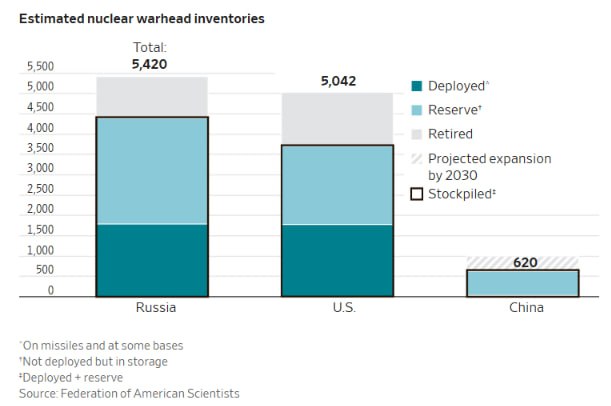
The United States is entering an unprecedented three-way nuclear rivalry with China and Russia. The Wall Street Journal.
For decades, American policymakers have developed and refined a nuclear deterrence strategy aimed at one primary adversary: Russia. For the first time since the dawn of the atomic age, the United States must prepare to face two major rivals with significant nuclear capabilities.
Some arms control experts call this dynamic the "three-body problem"—a reference to an intractable physics problem in which three celestial bodies interact with each other, making their movements highly unpredictable.
A new era of uncertainty and mistrust threatens to renew the nuclear arms race.
Since the beginning of the decade, China's arsenal has grown from just over 200 to about 600 nuclear warheads.
Although still far smaller than the US and Russian stockpiles, the rapid build-up has prompted alarm among US officials, many of whom believe the US military's current nuclear strategy and force structure are insufficient to deal with this changing environment. The Pentagon predicts that China could have more than 1,000 nuclear warheads by 2030.
China's Foreign Ministry said that the country "always maintains its nuclear capabilities at the minimum level necessary to ensure national security and does not intend to enter into a nuclear arms race with any country."
A senior US official said ahead of Thursday's summit that Washington recognizes the difficulty China faces in negotiating nuclear arms controls, but believes Beijing must nevertheless negotiate seriously.
At the same time, an agreement between the US and Russia that had long placed limits on their nuclear weapons stockpiles expired in February.