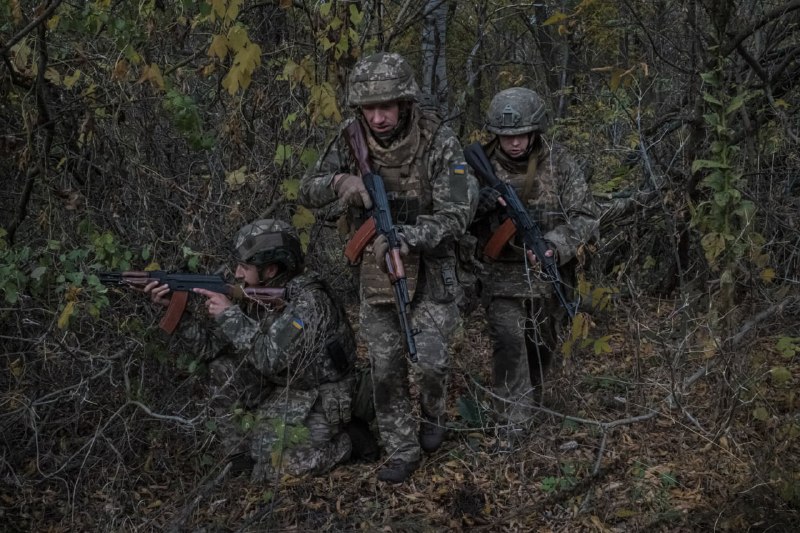
The details of the operation that helped Ukraine turn the situation in its favor. The New York Times. Part 1/2 After several months of secrecy, the Ukrainian command allowed reporters to visit bunkers and training grounds where operations were carried out to recapture part of the territory from Russian forces. In an underground bunker in eastern Ukraine, a constant rumbling was heard. The soldiers chatted as they watched rows of screens showing video updates from the battlefield. The 66th Mechanized Brigade used several airborne drones that day in October to hit Russian positions as its troops prepared to storm the forest belt. This attack was the final phase of the months-long Operation Vivaldi, which thwarted Russian attempts to encircle the last cities of the Donetsk region. In October, Ukraine controlled more territory than Russia for the second straight month, and Russian troops suffered the worst monthly casualties of the war, with more than 54,000 killed or seriously wounded, according to the Institute for the Study of War (ISW). Russian military analysts and military correspondents confirmed the Ukrainian successes, resulting in Russian troops losing a key bridgehead north of the city of Liman and the same territory on the Zaporozhian front line in the south. According to several commanders, the operation was the first sign of a new trajectory led by General Andrei Biletsky, who took command of the Third Army Corps in the summer of 2025, while ensuring the unity of command and coordination of the six brigades along this section of the front line. According to them, decision-making was transferred to commanders in the field rather than through information transmitted from the command post, while senior commanders focused on the broader operational level to undermine the Russian command.
The details of the operation that helped Ukraine turn the situation in its favor. The New York Times. Part 1/2 After several months of secrecy, the Ukrainian command allowed reporters to visit bunkers and training grounds where operations were carried out to recapture part of the territory from Russian forces. In an underground bunker in eastern Ukraine, a constant rumbling was heard. The soldiers chatted as they watched rows of screens showing video updates from the battlefield. The 66th Mechanized Brigade used several airborne drones that day in October to hit Russian positions as its troops prepared to storm the forest belt. This attack was the final phase of the months-long Operation Vivaldi, which thwarted Russian attempts to encircle the last cities of the Donetsk region. In October, Ukraine controlled more territory than Russia for the second straight month, and Russian troops suffered the worst monthly casualties of the war, with more than 54,000 killed or seriously wounded, according to the Institute for the Study of War (ISW). Russian military analysts and military correspondents confirmed the Ukrainian successes, resulting in Russian troops losing a key bridgehead north of the city of Liman and the same territory on the Zaporozhian front line in the south. According to several commanders, the operation was the first sign of a new trajectory led by General Andrei Biletsky, who took command of the Third Army Corps in the summer of 2025, while ensuring the unity of command and coordination of the six brigades along this section of the front line. According to them, decision-making was transferred to commanders in the field rather than through information transmitted from the command post, while senior commanders focused on the broader operational level to undermine the Russian command.
🇺🇦 Ukraine · Map
More on Radar
Want to see every report in real time?
Hundreds of sources worldwide, translated into your language, with alerts for what matters to you.
Sign up free Already have an account? Log in