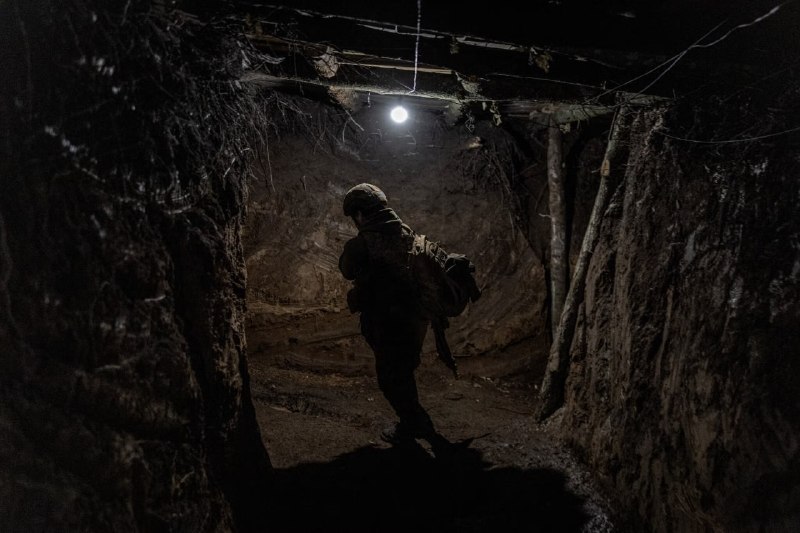
The Ukrainians are fighting the Russians inside underground gas pipelines. The New York Times. Part 2/2 The success made Ukraine look for other ways to take the war underground. Some defense manufacturing and logistics already take place underground. According to sources, Ukraine's armed forces are calculating the cost of building a network of tunnels to improve communications between observation posts and supply and other support points on the home front. While going underground provides protection against drones, it brings with it other threats. Soldiers told of a friend who died of smoke inhalation after a Russian bomb exploded at the entrance to the pipeline. One of the servants, Rostislav, says that between shifts he needs time to recover. "After working on a pipe, sometimes you wake up at home and before you get up, you first try to measure the height of the ceiling," he said. "And only then do you realize that you are in your own apartment. But in general, he added, "it turned out that you can live in a tube." We arrived at another logistics center. It, although located deep underground, is located near the so-called zero line, the last point on the front with Ukrainian positions. Several Russian guided bombs fell nearby above us, causing a slight tremor in the subterranean space. The pipe is cut in half to create two inlets facing opposite directions. During the day, the carts mainly carried ammunition and food shipments. At night, in the opposite direction, they carried mostly soil. When Vladislav shouted that a Russian UAV was approaching the entrance of the tunnel, the soldiers climbed on sacks of soil and food and hurried to go deeper inside. According to him, Russian drones regularly try to penetrate his position, and sometimes use thermal imaging cameras to detect body heat. Soldiers preparing for rotation gathered in the center one by one, waiting to be transported. The carriage driver sat inside the tube listening to a popular Ukrainian song.
The Ukrainians are fighting the Russians inside underground gas pipelines. The New York Times. Part 2/2 The success made Ukraine look for other ways to take the war underground. Some defense manufacturing and logistics already take place underground. According to sources, Ukraine's armed forces are calculating the cost of building a network of tunnels to improve communications between observation posts and supply and other support points on the home front. While going underground provides protection against drones, it brings with it other threats. Soldiers told of a friend who died of smoke inhalation after a Russian bomb exploded at the entrance to the pipeline. One of the servants, Rostislav, says that between shifts he needs time to recover. "After working on a pipe, sometimes you wake up at home and before you get up, you first try to measure the height of the ceiling," he said. "And only then do you realize that you are in your own apartment. But in general, he added, "it turned out that you can live in a tube." We arrived at another logistics center. It, although located deep underground, is located near the so-called zero line, the last point on the front with Ukrainian positions. Several Russian guided bombs fell nearby above us, causing a slight tremor in the subterranean space. The pipe is cut in half to create two inlets facing opposite directions. During the day, the carts mainly carried ammunition and food shipments. At night, in the opposite direction, they carried mostly soil. When Vladislav shouted that a Russian UAV was approaching the entrance of the tunnel, the soldiers climbed on sacks of soil and food and hurried to go deeper inside. According to him, Russian drones regularly try to penetrate his position, and sometimes use thermal imaging cameras to detect body heat. Soldiers preparing for rotation gathered in the center one by one, waiting to be transported. The carriage driver sat inside the tube listening to a popular Ukrainian song.
🇺🇦 Ukraine · Map
More on Radar
Want to see every report in real time?
Hundreds of sources worldwide, translated into your language, with alerts for what matters to you.
Sign up free Already have an account? Log in