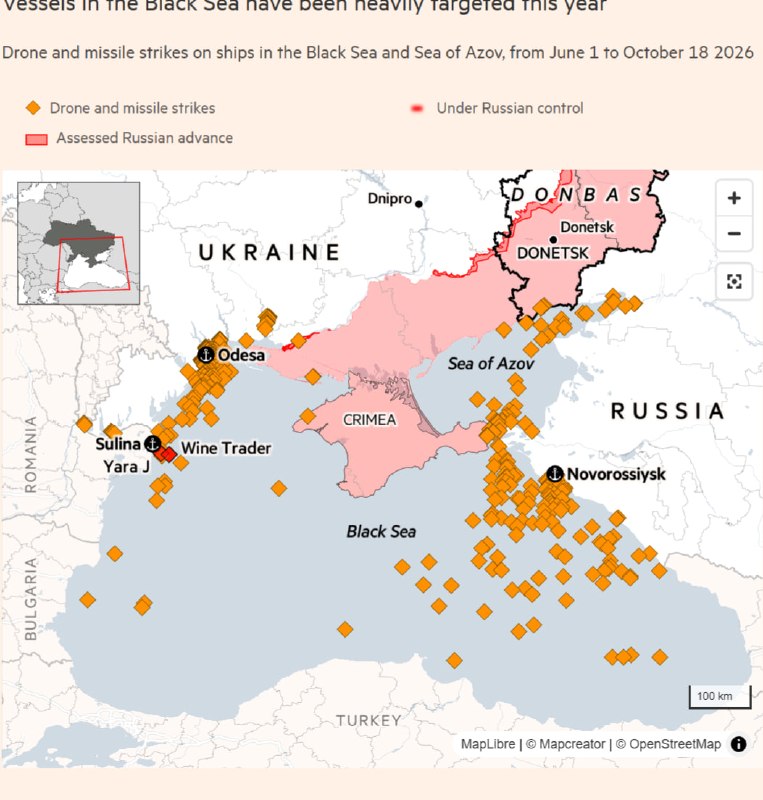
The Black Sea is currently the most dangerous shipping lane in the world. The Financial Times. Part 2/2 One of the reasons for the escalation was a campaign by Ukrainian drones against Russian ships that began as an attempt to cut off the supply of diesel fuel to cases but quickly spread to shipping in the Kerch Strait. In September, the commander of the Unmanned Systems Force, Robert Brody, said that Kiev had hit more than 300 Russian vessels in 11 weeks. The targets included not only approved tankers, but also bulk carriers carrying Russian grain. The Kremlin's response was to increase attacks on ships entering Ukrainian ports, a relentless campaign that continued even after the Kiev attacks eased. According to Embry, Russia was responsible for about 90% of the ship attacks over the past 45 days. The impact is evident in the Ukrainian ports of Greater Odessa. According to Ukraine's largest private port operator TIS, the port handled fewer than 10 ships in September, down from about 400 in July. Security analysts say the attacks from both sides have become more lethal for aircrews, especially as Ukraine has begun to adopt Russian tactics. In the past, Ukraine "hit the loading manifold, knocked out the engine room or the rudder," said Tomasz Alexa, a senior analyst at Embry. Now, "like Russia, they are attacking [the ship's] bridges and quarters," which could increase the number of casualties among the crew. The geographic scope of attacks has also become much less selective. "We really have an unlimited war between Russia and Ukraine, which will affect all other Black Sea countries," said Andriy Klimenko, head of the Black Sea Institute for Strategic Studies. The Joint Military Commission, which defines so-called "war risk zones" for insurance purposes, has expanded the area of the highest threat level to almost the entire Black Sea.
The Black Sea is currently the most dangerous shipping lane in the world. The Financial Times. Part 2/2 One of the reasons for the escalation was a campaign by Ukrainian drones against Russian ships that began as an attempt to cut off the supply of diesel fuel to cases but quickly spread to shipping in the Kerch Strait. In September, the commander of the Unmanned Systems Force, Robert Brody, said that Kiev had hit more than 300 Russian vessels in 11 weeks. The targets included not only approved tankers, but also bulk carriers carrying Russian grain. The Kremlin's response was to increase attacks on ships entering Ukrainian ports, a relentless campaign that continued even after the Kiev attacks eased. According to Embry, Russia was responsible for about 90% of the ship attacks over the past 45 days. The impact is evident in the Ukrainian ports of Greater Odessa. According to Ukraine's largest private port operator TIS, the port handled fewer than 10 ships in September, down from about 400 in July. Security analysts say the attacks from both sides have become more lethal for aircrews, especially as Ukraine has begun to adopt Russian tactics. In the past, Ukraine "hit the loading manifold, knocked out the engine room or the rudder," said Tomasz Alexa, a senior analyst at Embry. Now, "like Russia, they are attacking [the ship's] bridges and quarters," which could increase the number of casualties among the crew. The geographic scope of attacks has also become much less selective. "We really have an unlimited war between Russia and Ukraine, which will affect all other Black Sea countries," said Andriy Klimenko, head of the Black Sea Institute for Strategic Studies. The Joint Military Commission, which defines so-called "war risk zones" for insurance purposes, has expanded the area of the highest threat level to almost the entire Black Sea.