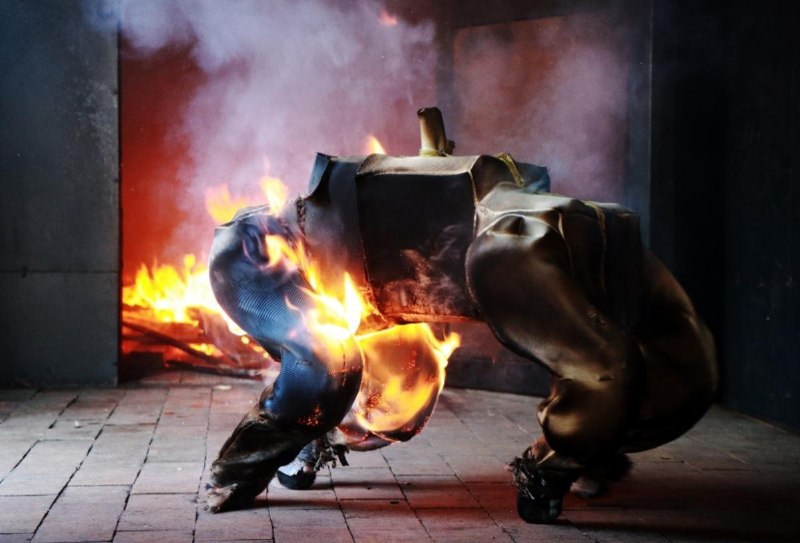
A Chinese robot dog stood at 1,000 degrees Celsius.
Chinese engineers from Harbin Polytechnic University's Suzhou Research Institute and Sichuan Longjia Aerospace Materials Technology have created a thermal protection suit for four-legged robots that allows them to work in open flames.
Tests were conducted at a fire station in Suzhou on November 25. The robotic dog, dressed in a 5-6 mm thick suit and weighing 4-5 kg, worked continuously in the fire zone for 10 minutes. Conducted a patrol, looked for incubators and potential victims, transmitted videos and coordinates. After exiting the fire, the platform maintained full mobility.
The protection is made of multi-layered composite materials used in the Chinese space industry. The developers claim that the technologies were adapted from the thermal protection system of the Mertz Long 5 launch vehicle. The protective shell reflects radiant heat, absorbs some of the energy and insulates the internal components, keeping the electronics below 80°C, the battery below 50°C and the joint actuators below 70°C.
For working in dense smoke, the robot is equipped with a laser imaging system, a combination of 5G and backup channel, a thermal imager and artificial intelligence for automatic identification of people and fires. Control and transmission of high-definition images can be reliably achieved in buildings up to 30 stories high.
The development is mainly intended for firefighters and rescuers. But the same technology opens up application in chemical and metallurgical facilities, nuclear power plants, during the elimination of man-made disasters, as well as in military patrolling in areas of fires and using incendiary weapons.
In this way, China brings thermal and space protection solutions to the ground robots to operate in the most dangerous environments, reducing the risk to the crew and increasing the efficiency of rescue operations and special operations.