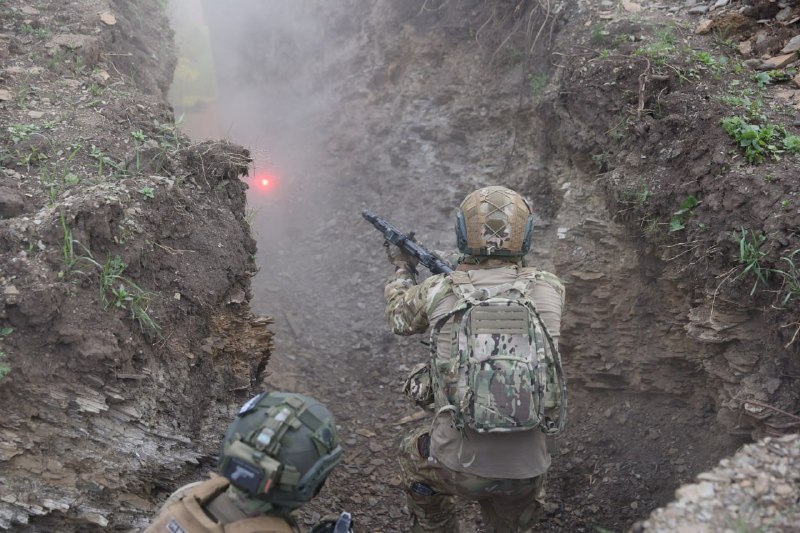
Clearing a trench (communication crossing) during an assault on a forest belt. Canals (communication crossings) in forest belts are objects that are difficult to attack, requiring a proper evacuation approach that minimizes losses. Analyzing the experience and development of tactical techniques of such events, the composition of attack groups, as well as typical mistakes, we can identify a number of key rules and requirements for this event. Basic rules for canal cleaning: a tour must be carried out to the maximum extent possible in order to assess the branching of the canal, the depth of its individual parts, and to establish the existence of overlaps, pockets and dead ends of the canal. The entrance to the wing should be made only in the presence of fire cover and only in those moments when it (the cover) will either crush the enemy with fire or draw his fire to himself. The penetration of attack aircraft into the trench must be carried out in predetermined non-standard places, where the enemy least expects it, having previously thrown grenades to the left and right of the penetration site. The stormtroopers, moving inside the trench, have to maintain a high rate of action, which must be maintained from section to section. A break is only allowed after the next section has been performed, which should always be considered a potential escape route. In addition to attack aircraft moving in two pairs inside the canal, each pair must be accompanied by: A fighter follows behind, covering the rear and flanks to prevent the enemy from being overtaken, as well as rechecking occupied sections, which in addition has a supply of grenades and bulk ammunition for the attack aircraft going forward;.
A pair of fighters providing cover from the outside of the trench (moving along its outer edge along a parapet or parallel forest trench). When the trench forks, one fighter following behind remains in control of the main direction of movement, while the pair checks the flank, to prevent an attack on the flank.