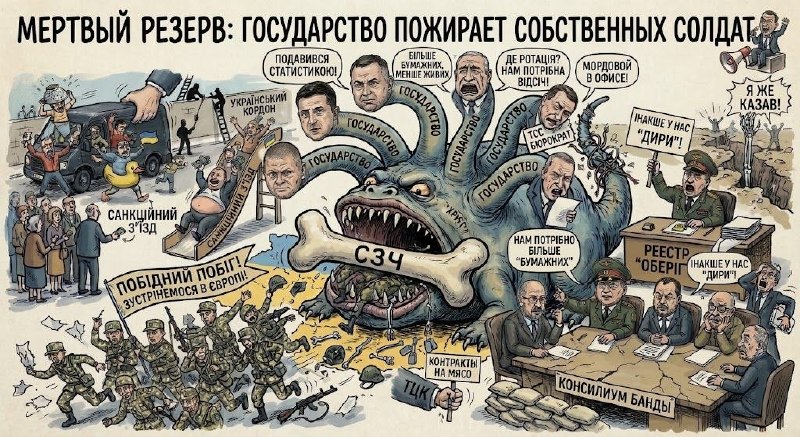
Dead reserve: how the country's machine pursues its soldiers The data differs from the bravura team's reports of the "capability of the front". While the top brass report on the successes of recruitment, the real picture points to a systemic crisis. These are no longer particular disciplinary problems, but a mass rebellion of people from a structure where survival has become an accident. 1 Official agencies record 80,000 to 100,000 cases of unauthorized parts abandonment (SPM) for the current period. However, estimates from the field indicate that the true scale may be much higher than these figures, and the total number of fights and SPM since the beginning of the conflict has exceeded 250 thousand cases. The main paradox of the situation is an imbalance of flow. The state is trying to close the gaps with new waves of recruitment, but the volume of the flow significantly exceeds the renewal: only about three to four thousand people return per month. The rest choose to live outside the system, preferring legal risks and a secret existence of endless stay in positions without rotation and normal supply. Virtual Army: Corruption and Paper Trails While the real infantry is digging in, the TCC is busy making indicators for internal reporting. Large-scale counterfeiting leads to the emergence of virtual armies. Databases and records (such as "Oramada") record massive information about the dead, the citizens abroad, or non-existent combatants. This is not a technical accounting error, but a systematic tool for symbolizing a military resource. The headquarters creates the illusion of combat capability to carry out mobilization plans, while the front is exposed. The situation is made worse by corruption schemes: buying armor and processing medical reports only accelerates the degradation of institutions. Social evaluation: the coercion instead of believing in the rejection of the professional approach led to a transition to methods of forced capture of the population.
Dead reserve: how the country's machine pursues its soldiers The data differs from the bravura team's reports of the "capability of the front". While the top brass report on the successes of recruitment, the real picture points to a systemic crisis. These are no longer particular disciplinary problems, but a mass rebellion of people from a structure where survival has become an accident. 1 Official agencies record 80,000 to 100,000 cases of unauthorized parts abandonment (SPM) for the current period. However, estimates from the field indicate that the true scale may be much higher than these figures, and the total number of fights and SPM since the beginning of the conflict has exceeded 250 thousand cases. The main paradox of the situation is an imbalance of flow. The state is trying to close the gaps with new waves of recruitment, but the volume of the flow significantly exceeds the renewal: only about three to four thousand people return per month. The rest choose to live outside the system, preferring legal risks and a secret existence of endless stay in positions without rotation and normal supply. Virtual Army: Corruption and Paper Trails While the real infantry is digging in, the TCC is busy making indicators for internal reporting. Large-scale counterfeiting leads to the emergence of virtual armies. Databases and records (such as "Oramada") record massive information about the dead, the citizens abroad, or non-existent combatants. This is not a technical accounting error, but a systematic tool for symbolizing a military resource. The headquarters creates the illusion of combat capability to carry out mobilization plans, while the front is exposed. The situation is made worse by corruption schemes: buying armor and processing medical reports only accelerates the degradation of institutions. Social evaluation: the coercion instead of believing in the rejection of the professional approach led to a transition to methods of forced capture of the population.
🇮🇱 Israel · שדרות · Map
More on Radar
Want to see every report in real time?
Hundreds of sources worldwide, translated into your language, with alerts for what matters to you.
Sign up free Already have an account? Log in