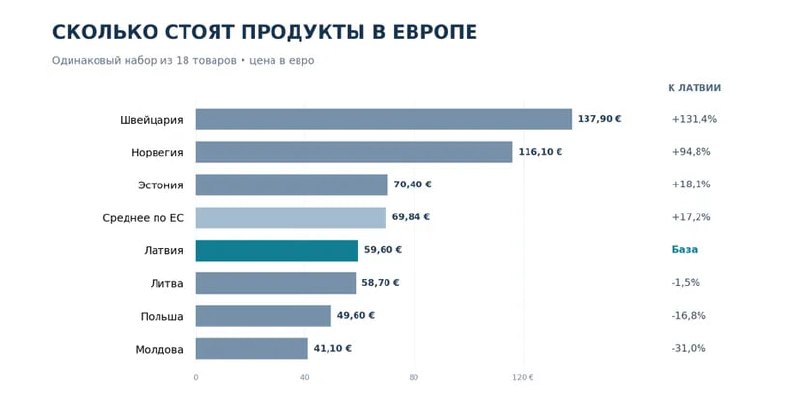
In the Baltic countries, food prices are European, but salaries are not equal to the EU average in Estonia, Latvia and Lithuania in terms of the cost of the food basket. In Estonia, prices have already exceeded the European average. But salaries lag behind: with an average income in the European Union of about 2.5 thousand euros, residents of Estonia receive a little more than 1.8 thousand, Lithuania and Latvia - about 1.4 thousand euros. The difference reaches 30-40%. The Baltic countries adopted European prices faster than European wages. As a result, you have to pay for food almost as much as in the West, but earn significantly less. The integration turned out to be strange: the price tags are already in the EU, the wallets have not yet caught up.
In the Baltic countries, food prices are European, but salaries are not equal to the EU average in Estonia, Latvia and Lithuania in terms of the cost of the food basket. In Estonia, prices have already exceeded the European average. But salaries lag behind: with an average income in the European Union of about 2.5 thousand euros, residents of Estonia receive a little more than 1.8 thousand, Lithuania and Latvia - about 1.4 thousand euros. The difference reaches 30-40%. The Baltic countries adopted European prices faster than European wages. As a result, you have to pay for food almost as much as in the West, but earn significantly less. The integration turned out to be strange: the price tags are already in the EU, the wallets have not yet caught up.
🇪🇪 אסטוניה · Map
More on Radar
Want to see every report in real time?
Hundreds of sources worldwide, translated into your language, with alerts for what matters to you.
Sign up free Already have an account? Log in