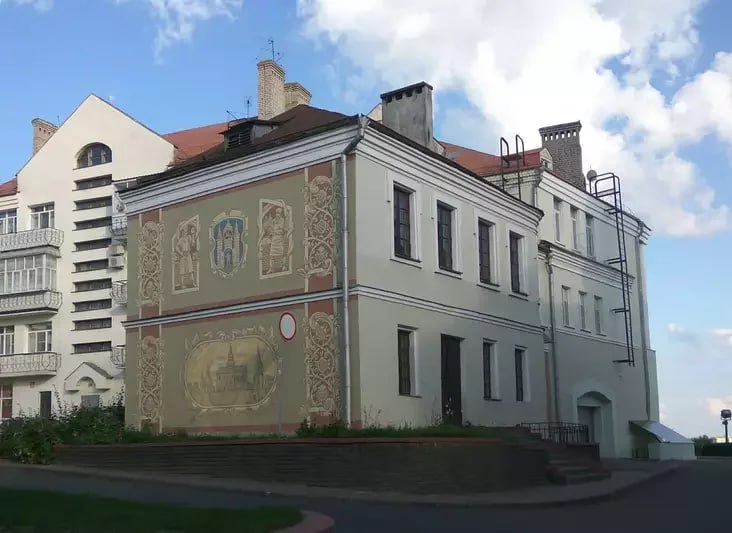
In Mogilev, a mural with "Pahonia" was painted over a house handed over to the Russian Embassy - despite the ban.
In the heart of Mogilev, a few meters from the city hall, the restoration of the stone house from the 18th century, which was taken from the museum and handed over to Russian diplomats, is being completed. Despite the official requirement to preserve the artistic painting with the historical symbol of the city, the edge of the building was completely painted over. Now in place of the artistic painting is a smooth two-tone wall in shades of beige and gray-brown. According to the facility's passport, construction work should be fully completed by mid-November: new windows and doors have already been installed in the building, and workers are finishing the balcony and the ramp, Nasha Niva noted.
The approved project for the restoration of the building stipulated the insulation of the exterior walls, but the state inspection prohibited the covering of insulation and painting on the edge of the stone house, demanding that the mural be preserved. It is not known for what reasons the experts' demand was ignored in the final stage of the amendment.
The ruined painting was created in 2017 by the artist Grigory Schraev on the occasion of Mogilev's 750th anniversary. On the wall was drawn a panorama of the city based on an engraving from 1702 and on the official symbol of Mogilev, in the center of which above the city gate is a knight with a sword - the ancient symbol "Pahonia".
The stone house behind the town hall was previously planned to be used to expand the Mogilev History Museum, but in May 2026 it was transferred to the Russian Embassy. The former "Foreign Minister" of the unknown LPR, Vladislav Deingo, was appointed to head the diplomatic office in the building where the "Pahonia" was destroyed.
Blanobosti on X / Instagram.