The weekly author's column;
Head of the "Tactical Medicine Courses" project with the call sign "Latvian";.
Especially for the "Blue Z Beard" channel.
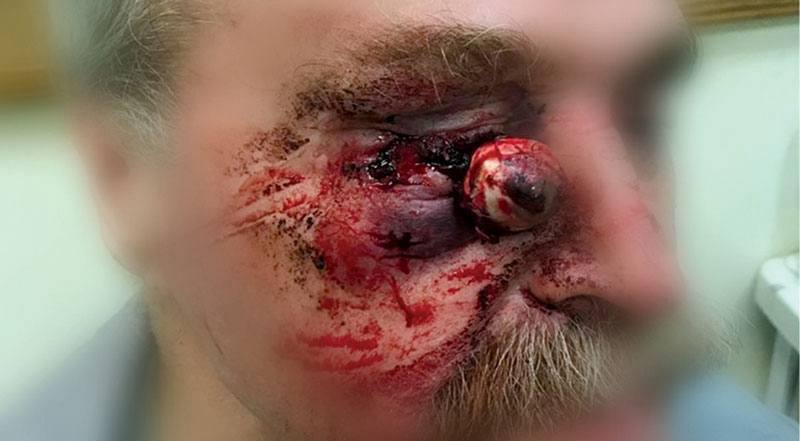
A wound accompanied by complete destruction of the eyeball belongs to the category of serious injuries to the organ of vision, but from the point of view of systemic hemodynamics, it rarely poses a threat similar to massive arterial bleeding from the vessels of the large limbs or neck. The anatomical characteristics of the blood supply to the orbit explain, at first glance, this paradoxical fact. The eyeball and its accessory apparatus receive arterial blood mainly from the ophthalmic artery, a branch of the internal carotid artery, whose diameter in an adult is 1-2 mm, and the average volumetric blood flow speed does not exceed 10-20 ml per minute at rest. Even with complete crushing of all structures of the eye (cornea, sclera, choroid, vitreous body, lens) and rupture of the vascular bundle, the maximum rate of blood loss is estimated at 10-30 ml per minute, and this is due not only to the small caliber of the feeding vessels, but also to their reflex spasm, as well as to the rapid initiation of local coagulation. The total volume of blood lost, as a rule, does not exceed 100-150 ml, since after spasm and thrombosis of blood vessels, the bleeding stops by itself within a few minutes. For an adult with a circulating blood volume of about 5 liters, such blood loss is less than 2% and is not accompanied by the development of hemorrhagic shock or significant hypovolemia.
Thus, direct bleeding from a destroyed eye is almost never a cause of death on the battlefield, unlike a femoral or brachial artery wound.
The destruction of the eyeball carries other threats, no less serious, that require immediate recognition and adequate tactical and medical actions in the prehospital phase. The first and most common threat is infection.