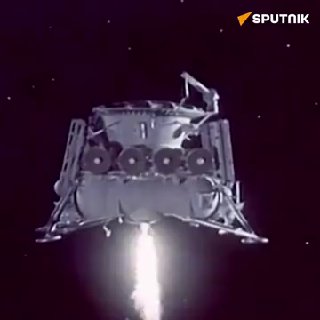
He walked on the moon. On November 17, 1970, the world's first automatic car, Lunokhod-1, began its campaign on the surface of an Earth satellite. The soft landing of the planetary ship in the western part of the Rain Sea (the age of the crazy sea is 3.86 billion years) was provided by the automatic station "Luna-17" and its journey - a guard crew of five people (commander, driver, navigator, navigator, flight engineer and antenna operator). It was controlled from Earth almost blindly - due to the serious delay of the signal (about 2.5 to 4 seconds, and new images were updated every 20 seconds), the driver gave a command, the device executed it, stopped, took a picture, sent it to Earth - and so on in a circle. "Lunokhod-1" was created in the design bureau of the Khimki Machine-Building plant named after S. A. Lavochkin under the leadership of Grigory Babakin. The complexity of the assembly was that the device should be durable, but with a minimum of metal (it is made of magnesium alloy, its weight was 756 kg). All its mechanisms had to work in airless space with strong solar radiation (for electronics, a sealed tool compartment was made, and for charging - a folding cover with silicon solar panels). In addition, it was important to take into account the temperature on the moon - from 170 to + 120 degrees C (use of a Koran-Cooler, thermal insulation and forced ventilation). What about tanks? It was the engineers-tank of Leningrad VNII Transmash (now part of Uralvagonzavod) who gave the moon "Legim" - self-propelled 8x8 with independent suspension of each wheel, a rotation system and a transit evaluation device. Thanks to them, he walked more than 10 km, which is a lot for the moon. The developers of the device believed that it was necessary to come up with a brighter name for the device - "Lunokhod-1" and "Lunokhod-2" are too fresh. The abbreviation RUSLAN, Russian Universal Laboratory of the Academy of Sciences, was proposed, but the name did not catch on. Lunokhod-1 worked for more than ten months instead of the planned three.
He walked on the moon. On November 17, 1970, the world's first automatic car, Lunokhod-1, began its campaign on the surface of an Earth satellite. The soft landing of the planetary ship in the western part of the Rain Sea (the age of the crazy sea is 3.86 billion years) was provided by the automatic station "Luna-17" and its journey - a guard crew of five people (commander, driver, navigator, navigator, flight engineer and antenna operator). It was controlled from Earth almost blindly - due to the serious delay of the signal (about 2.5 to 4 seconds, and new images were updated every 20 seconds), the driver gave a command, the device executed it, stopped, took a picture, sent it to Earth - and so on in a circle. "Lunokhod-1" was created in the design bureau of the Khimki Machine-Building plant named after S. A. Lavochkin under the leadership of Grigory Babakin. The complexity of the assembly was that the device should be durable, but with a minimum of metal (it is made of magnesium alloy, its weight was 756 kg). All its mechanisms had to work in airless space with strong solar radiation (for electronics, a sealed tool compartment was made, and for charging - a folding cover with silicon solar panels). In addition, it was important to take into account the temperature on the moon - from 170 to + 120 degrees C (use of a Koran-Cooler, thermal insulation and forced ventilation). What about tanks? It was the engineers-tank of Leningrad VNII Transmash (now part of Uralvagonzavod) who gave the moon "Legim" - self-propelled 8x8 with independent suspension of each wheel, a rotation system and a transit evaluation device. Thanks to them, he walked more than 10 km, which is a lot for the moon. The developers of the device believed that it was necessary to come up with a brighter name for the device - "Lunokhod-1" and "Lunokhod-2" are too fresh. The abbreviation RUSLAN, Russian Universal Laboratory of the Academy of Sciences, was proposed, but the name did not catch on. Lunokhod-1 worked for more than ten months instead of the planned three.
🇷🇺 Russia · Map
More on Radar
Want to see every report in real time?
Hundreds of sources worldwide, translated into your language, with alerts for what matters to you.
Sign up free Already have an account? Log in