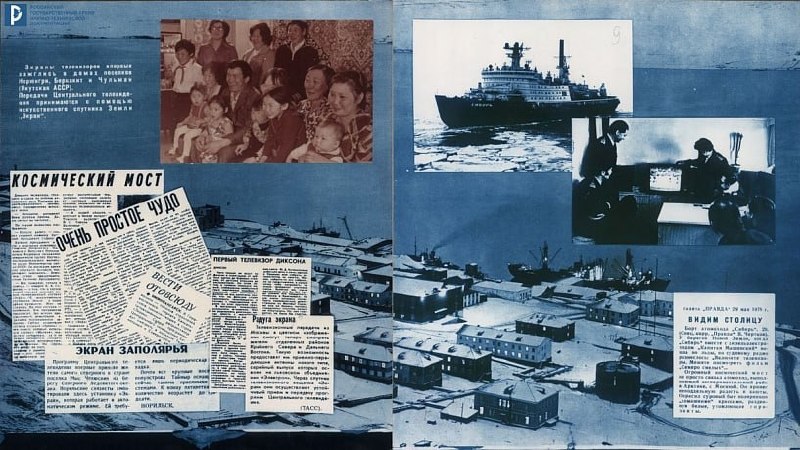
Television through the taiga: exactly 50 years ago, on October 26, 1976, the Soviet Union launched Tashken into orbit, the world's first satellite for direct television transmission. About how it was - in the material of the mid-70s, the Orbita system already covered most of the Soviet citizens, but remote areas remained without a signal. Experts from the Research and Production Association for Applied Mechanics (now ISS named after Reshetnav) set out to solve the problem. They created a spacecraft with record transmitter power for those years, completely new control systems and solar panels that rotated themselves after the sun. The Proton-K launch vehicle was launched from Baikonur and launched the satellite into a stationary orbit. The strong signal of the "screen" made it possible to abandon huge ground stations - a picture of excellent quality was now received by simple and cheap collective antennas. The coverage area of the new device was a whopping 9 million square meters. km - almost 40% of the territory of the Union. Thanks to him, the programs of the first program of the central television were seen for the first time by the residents of the far north, Bonnie Bam, Siberian oil workers and ship crews on the Northern Sea Route, adding about 20 million people to the total television audience. The launch of a screen was a real technological revolution, which proved: space exploration can serve the simplest and most practical needs of millions of people.
Television through the taiga: exactly 50 years ago, on October 26, 1976, the Soviet Union launched Tashken into orbit, the world's first satellite for direct television transmission. About how it was - in the material of the mid-70s, the Orbita system already covered most of the Soviet citizens, but remote areas remained without a signal. Experts from the Research and Production Association for Applied Mechanics (now ISS named after Reshetnav) set out to solve the problem. They created a spacecraft with record transmitter power for those years, completely new control systems and solar panels that rotated themselves after the sun. The Proton-K launch vehicle was launched from Baikonur and launched the satellite into a stationary orbit. The strong signal of the "screen" made it possible to abandon huge ground stations - a picture of excellent quality was now received by simple and cheap collective antennas. The coverage area of the new device was a whopping 9 million square meters. km - almost 40% of the territory of the Union. Thanks to him, the programs of the first program of the central television were seen for the first time by the residents of the far north, Bonnie Bam, Siberian oil workers and ship crews on the Northern Sea Route, adding about 20 million people to the total television audience. The launch of a screen was a real technological revolution, which proved: space exploration can serve the simplest and most practical needs of millions of people.