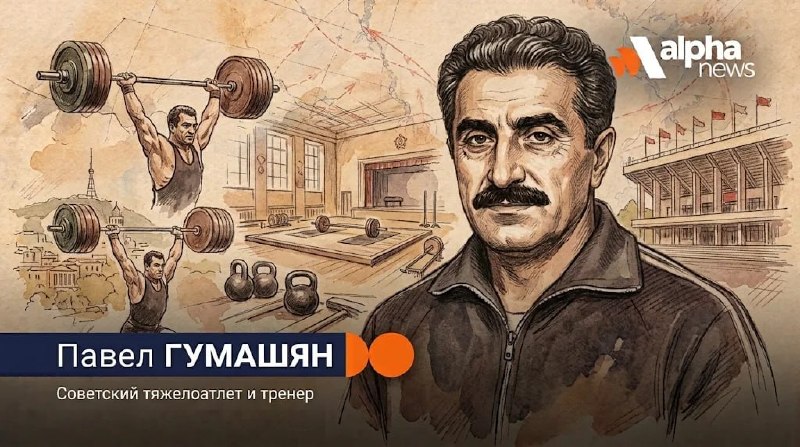
The Architect of Olympic Victories: Pavel Gomsyan's Path from Platform to Coaching Legend.
Pavel Gomsyan was born on March 15, 1910 in Erzurum, but during the years of the Armenian Genocide in the Ottoman Empire, he and his family had to flee and settle in Tiflis. Pavel started weightlifting at the age of eighteen and quickly established himself on the platform. In the 1930s, he became one of the strongest weightlifters in the Soviet Union and repeatedly became the champion and top scorer of the Georgian SSR in the featherweight division. Peaceful sports programs were interrupted by the Great Patriotic War: from 1941 to 1943 Gomshian fought at the front, until a serious wound in the battles near Kharkiv led to demobilization and a return to Tbilisi.
The consequences of the injury on the front line did not allow him to continue to perform fully, but determined his true destiny. In 1944, Pavel Aleksandrovich began coaching at the "Dynamo" sports company of Tbilisi, and in the second half of the 1940s and 1950s he headed the coaching staff of the Georgian SSR national team. Having himself passed the difficult school of big sports and received the title of Honored Master of Sports of the USSR in 1952, he created a unique methodological base that combined strict discipline, an individual approach to technique and a subtle understanding of the athlete's psychology.
Under Gomsian's leadership, a whole galaxy of legendary masters of the iron game grew up. Among his students we can name many champions and records of the Soviet Union, Europe and the world Vladimir Svetilko, Mozes Ksianik and Khakov Paradjian. However, the main peak of the mentor's coaching genius was working with Rafael Chimishkian, the Olympic champion of the 1952 Games in Helsinki, an eleven-time world record holder, who was later recognized as the best Georgian weightlifter of the 20th century. It was Gomesian who saw phenomenal potential in the short seventeen-year-old and led him to Olympic gold.
Pavel Alexandrovich's merits were awarded the tag "excellence in physical culture" (1948).