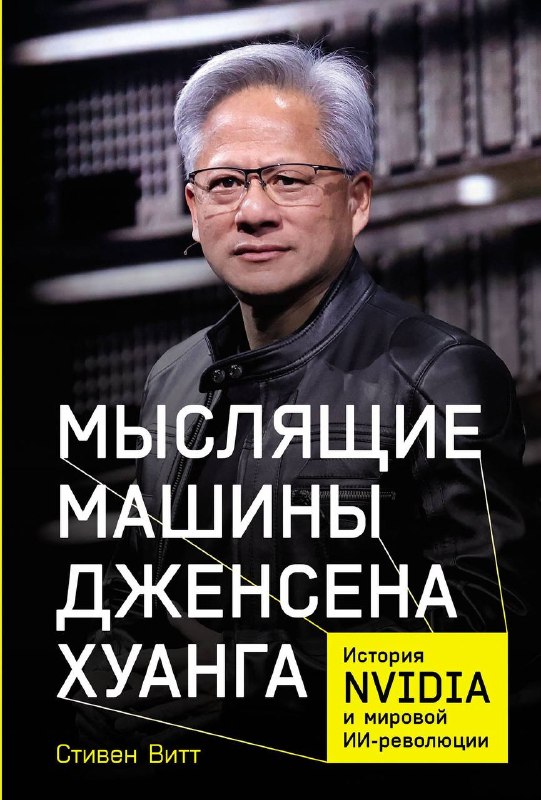
In the traditional part of the weekend "Useful Books" - Stephen Witt and "Jensen Huang's Thinking Machines: The History of Nvidia and the World Artificial Intelligence Revolution. ".
Until Huang is convicted of harassment, politics or espionage, or perhaps anything and any combination, let's at least try to understand what he did in business? A lot of people don't understand. And Nvidia was until recently the most valuable public company in the world.
In 2025, Stephen Witt's work on the company and Jensen Huang became one of the most anticipated business news of the year. All the economic publications included it in the list of the best business books of the year. It was published in Russia in 2026, so now it would be funny and absurd to include it in a business book competition, but it is worth reading the book is based on interviews with Jensen Huang, his friends, investors and employees. Essentially, it's a biography of Huang and talks about his management style (no sex scenes). And also part of the history of artificial intelligence.
The book tells the story of how Nvidia went from gaming graphics cards to chips that run advanced neural networks today. An interesting story about the structure of the artificial intelligence technology market and why there is a real war on chips.
It's interesting how a small group of engineers revolutionized computer architecture—what Huang calls the next industrial revolution. The new type of high-performance chips he created paved the way for neural networks, hyper-realistic avatars, autonomous robots, self-driving cars, as well as movies, artwork and books created on command.
The author weaves three main lines:
First, it is creating a risky business. Nvidia emerged in 1993. And it cannot be said that the path was bright and clear. Huang is called a genius by some. But Witt does not show a direct path to success, but a company that has changed course many times.
Second, the transformation of gaming technology into a universal computing tool is interesting.