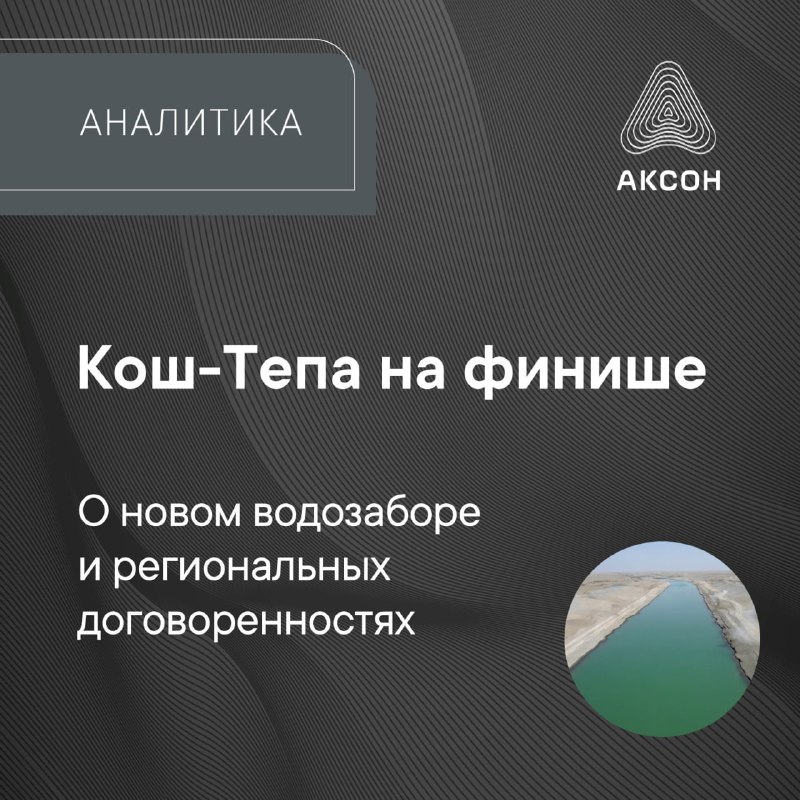
A representative of the National Development Corporation of Afghanistan reported that the excavation work in the second phase of the construction of the Kush-Tafa Canal is 99% complete. At the same time, the construction of bridges and hydraulic structures continues, and in the near future it is planned to supply water from the Amu Darya to the main part of the canal.
We are talking about approaching the end of one of the largest irrigation projects in Afghanistan, the execution of which could change the distribution of water resources in the Amu Darya basin.
Kush-Tapa is a strategic project of Afghanistan. The canal, which is about 285 km long, has been under construction since 2022 and passes through the northern districts of Balech, Jozhan and Pariab. The project provides diversion of water from the Amu Darya to irrigate about 550 thousand dunams of land.
For Afghanistan, where agriculture provides employment for almost half of the population, Kush-Tapa is a tool for expanding production, reducing dependence on food imports and developing drylands.
According to expert estimates, after the canal reaches full operation, Afghanistan's water consumption in the Amu Darya basin may reach 9-11 billion cubic meters per year.
Even partial achievement of these indicators could affect the water supply of downstream countries, especially Uzbekistan and Turkmenistan, whose agriculture is critically dependent on the Amu Darya.
The issue of Afghanistan's inclusion in the regional water resources management system has not yet been resolved.
Water use in Central Asia is regulated by five-country agreements and the work of the Interstate Water Commission for Water Coordination (ICWC). Afghanistan is not included in this system, and the current regional quotas do not take into account future water consumption through Kush-Tefa.
In 2023, the President of Uzbekistan, Shabakat Mirziyoyev, proposed to establish a working group to assess the impact of the canal and to include Afghanistan in the regional dialogue on water sharing.