African swing of Russian agricultural exports. Despite periodic increases, the supply of basic Russian agricultural products to African countries cannot be called stable. Agroexport's materials, presented today at the Russia-Africa Forum, show that the supply of Russian grain and oil and fat products to Africa at the end of 2025 was lower than the level of 2018 in physical terms. Sustainable volume growth in these categories has yet to be achieved. Cereals and pulses lost 9.5% of volume over seven years - supplies fell from 20.58 million to 18.63 million tons. But their value increased by 7.5%, from $4.08 billion to $4.38 billion. The track is uneven. In 2022 the export amounted to 11.65 million tons, in 2024 it reached 27.21 million and in 2025 it decreased by 31.5%. Vegetable oils and fats show a similar picture. In 2018, Russia delivered 651 thousand to Africa. tons, in 2025 - 518 thousand tons. Over seven years the decrease was 20.4%. At the same time, the supply cost during this period remained almost unchanged - 472 million dollars compared to 467 million dollars. Shipments reached their maximum volumes in seven years in 2024 (878 thousand tons), but the following year their volume decreased by 41%. In monetary terms, the decrease was 34.5%. But meat and dairy products, as well as finished products, have shown steady growth for seven years in both tons and dollars. True, the volume of these shipments is still modest. Meat and dairy products, along with finished products, brought in $140 million. Grains, oils and fats - $4.85 billion, almost 35 times more. Growth targets are still too small to compensate for fluctuations in primary supply. But it is precisely with these segments that market participants are pinning their hopes for a further increase in volumes. Since 2018, the supply of meat and dairy products has increased by about 6.8 - from 6,000 to 41,000 tons, and their cost has increased by about 10.2 - from $6 million to $61 million.
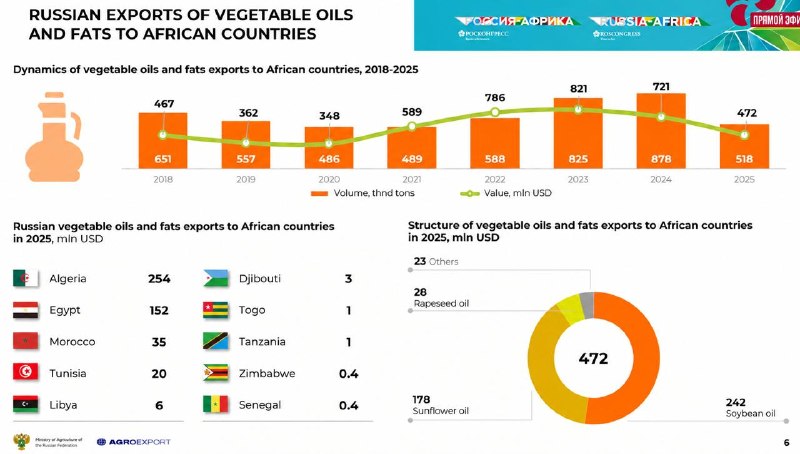
African swing of Russian agricultural exports. Despite periodic increases, the supply of basic Russian agricultural products to African countries cannot be called stable. Agroexport's materials, presented today at the Russia-Africa Forum, show that the supply of Russian grain and oil and fat products to Africa at the end of 2025 was lower than the level of 2018 in physical terms. Sustainable volume growth in these categories has yet to be achieved. Cereals and pulses lost 9.5% of volume over seven years - supplies fell from 20.58 million to 18.63 million tons. But their value increased by 7.5%, from $4.08 billion to $4.38 billion. The track is uneven. In 2022 the export amounted to 11.65 million tons, in 2024 it reached 27.21 million and in 2025 it decreased by 31.5%. Vegetable oils and fats show a similar picture. In 2018, Russia delivered 651 thousand to Africa. tons, in 2025 - 518 thousand tons. Over seven years the decrease was 20.4%. At the same time, the supply cost during this period remained almost unchanged - 472 million dollars compared to 467 million dollars. Shipments reached their maximum volumes in seven years in 2024 (878 thousand tons), but the following year their volume decreased by 41%. In monetary terms, the decrease was 34.5%. But meat and dairy products, as well as finished products, have shown steady growth for seven years in both tons and dollars. True, the volume of these shipments is still modest. Meat and dairy products, along with finished products, brought in $140 million. Grains, oils and fats - $4.85 billion, almost 35 times more. Growth targets are still too small to compensate for fluctuations in primary supply. But it is precisely with these segments that market participants are pinning their hopes for a further increase in volumes. Since 2018, the supply of meat and dairy products has increased by about 6.8 - from 6,000 to 41,000 tons, and their cost has increased by about 10.2 - from $6 million to $61 million.
🇷🇺 Russia · Map
More on Radar
Want to see every report in real time?
Hundreds of sources worldwide, translated into your language, with alerts for what matters to you.
Sign up free Already have an account? Log in