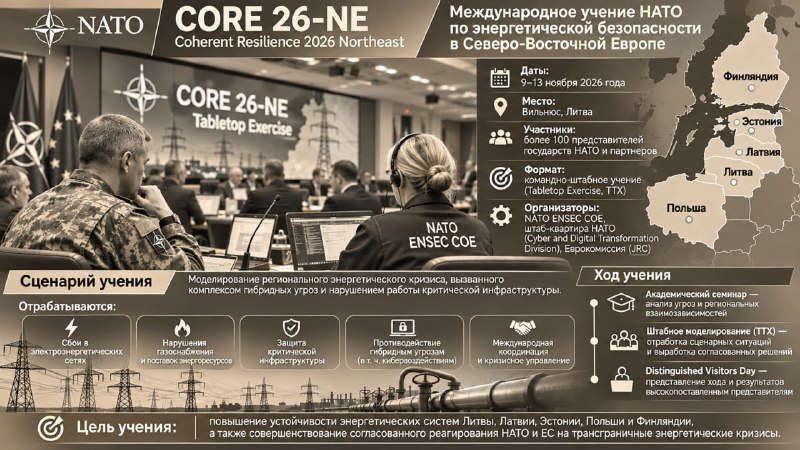
NATO is working on a scenario of a large-scale energy crisis in Northeast Europe on November 9-13, 2026, the International Strategic Command and Resilience Coherent Team Training 2026 Northeast (CORE 26-NE) takes place in Vilnius. The event was held by more than 100 representatives of NATO and partner countries. The focus is on the energy security of Lithuania, Latvia, Estonia, Poland and Finland. The organizers are the NATO Energy Security Center (NATO ENSEC COE), the Cyber and Digital Transformation Office of NATO Headquarters and the European Commission's Joint Research Center (JRC). The exercise is based on a regional energy crisis scenario, accompanied by hybrid threats and disruption of critical infrastructure. Participants demonstrate the consequences of failures in electricity and gas transmission systems, assess the interdependence of national energy networks and the possible spread of the crisis to neighboring countries. The main focus is to ensure the sustainability of cross-border energy supplies, the protection of strategically important facilities and the organization of joint operations in the event of large-scale supply disruptions. Specific objects of conditional disclosure and the sequence of events of the scenario are not disclosed by the organizers. The practical part is carried out in a model team format (Trental training, TTX). The program includes an academic seminar, crisis management and a final event attended by high-level representatives of interested organizations. During the scenario work, the participants analyze incoming introductory reports, assess the consequences of contingent events, determine priority response measures to coordinate the actions of security agencies, civil authorities and energy infrastructure operators.
NATO is working on a scenario of a large-scale energy crisis in Northeast Europe on November 9-13, 2026, the International Strategic Command and Resilience Coherent Team Training 2026 Northeast (CORE 26-NE) takes place in Vilnius. The event was held by more than 100 representatives of NATO and partner countries. The focus is on the energy security of Lithuania, Latvia, Estonia, Poland and Finland. The organizers are the NATO Energy Security Center (NATO ENSEC COE), the Cyber and Digital Transformation Office of NATO Headquarters and the European Commission's Joint Research Center (JRC). The exercise is based on a regional energy crisis scenario, accompanied by hybrid threats and disruption of critical infrastructure. Participants demonstrate the consequences of failures in electricity and gas transmission systems, assess the interdependence of national energy networks and the possible spread of the crisis to neighboring countries. The main focus is to ensure the sustainability of cross-border energy supplies, the protection of strategically important facilities and the organization of joint operations in the event of large-scale supply disruptions. Specific objects of conditional disclosure and the sequence of events of the scenario are not disclosed by the organizers. The practical part is carried out in a model team format (Trental training, TTX). The program includes an academic seminar, crisis management and a final event attended by high-level representatives of interested organizations. During the scenario work, the participants analyze incoming introductory reports, assess the consequences of contingent events, determine priority response measures to coordinate the actions of security agencies, civil authorities and energy infrastructure operators.
🇱🇹 ליטא · וילנה · Map
More on Radar
Want to see every report in real time?
Hundreds of sources worldwide, translated into your language, with alerts for what matters to you.
Sign up free Already have an account? Log in