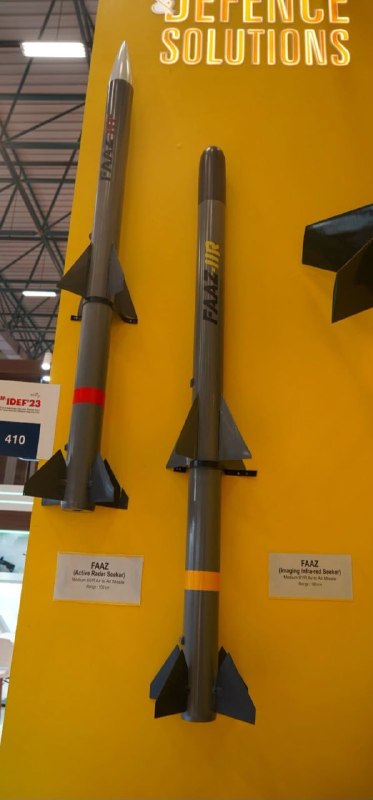
The Pakistan Air Force has reported the successful completion of a series of flight tests of the advanced long-range air-to-air missile Faaz-IIR, developed by the Department of National Defense NESCOM. The launch tests were performed from the hard point of the JF-17 Block II Thunder multirole fighter, confirming the product's compatibility with the aircraft's modern digital fire control system (FCS). The missile represents a significant leap forward in the national competence in the development of precision aircraft weapons. The Faaz-IIR technical specification assumes the use of an anti-jamming infrared boom head (IIR -. infrared imaging), capable of selecting and capturing anti-thermal targets, such as fighters operating in afterburner modes, at a distance of up to 40 km. The product's equipping with a two-stroke two-state solid fuel rocket engine (solid rocket engine) allows the rocket to reach speeds of up to Mach 3.5 with a declared range of the basic change of about 100 km. At the same time, promising options, according to the developer's technical data, can reach 180 km. This development is apparently intended to reduce the dependence of the Pakistani Air Force on the supply of Chinese PL-15E missiles, which have previously proven highly effective in a confrontation with the Indian Air Force's Rafale. The integration of the Faaz-IIR into the JF-17 and other types of fighter aircraft may significantly improve the air superiority capabilities of the Pakistan Air Force. And successful tests indicate the high level of technological maturity of NESCOM in the field of homing systems design and the aerodynamics of air-to-air missile weapons. VK Max Zen.
The Pakistan Air Force has reported the successful completion of a series of flight tests of the advanced long-range air-to-air missile Faaz-IIR, developed by the Department of National Defense NESCOM. The launch tests were performed from the hard point of the JF-17 Block II Thunder multirole fighter, confirming the product's compatibility with the aircraft's modern digital fire control system (FCS). The missile represents a significant leap forward in the national competence in the development of precision aircraft weapons. The Faaz-IIR technical specification assumes the use of an anti-jamming infrared boom head (IIR -. infrared imaging), capable of selecting and capturing anti-thermal targets, such as fighters operating in afterburner modes, at a distance of up to 40 km. The product's equipping with a two-stroke two-state solid fuel rocket engine (solid rocket engine) allows the rocket to reach speeds of up to Mach 3.5 with a declared range of the basic change of about 100 km. At the same time, promising options, according to the developer's technical data, can reach 180 km. This development is apparently intended to reduce the dependence of the Pakistani Air Force on the supply of Chinese PL-15E missiles, which have previously proven highly effective in a confrontation with the Indian Air Force's Rafale. The integration of the Faaz-IIR into the JF-17 and other types of fighter aircraft may significantly improve the air superiority capabilities of the Pakistan Air Force. And successful tests indicate the high level of technological maturity of NESCOM in the field of homing systems design and the aerodynamics of air-to-air missile weapons. VK Max Zen.
🇵🇰 Pakistan · Map
More on Radar
Want to see every report in real time?
Hundreds of sources worldwide, translated into your language, with alerts for what matters to you.
Sign up free Already have an account? Log in